
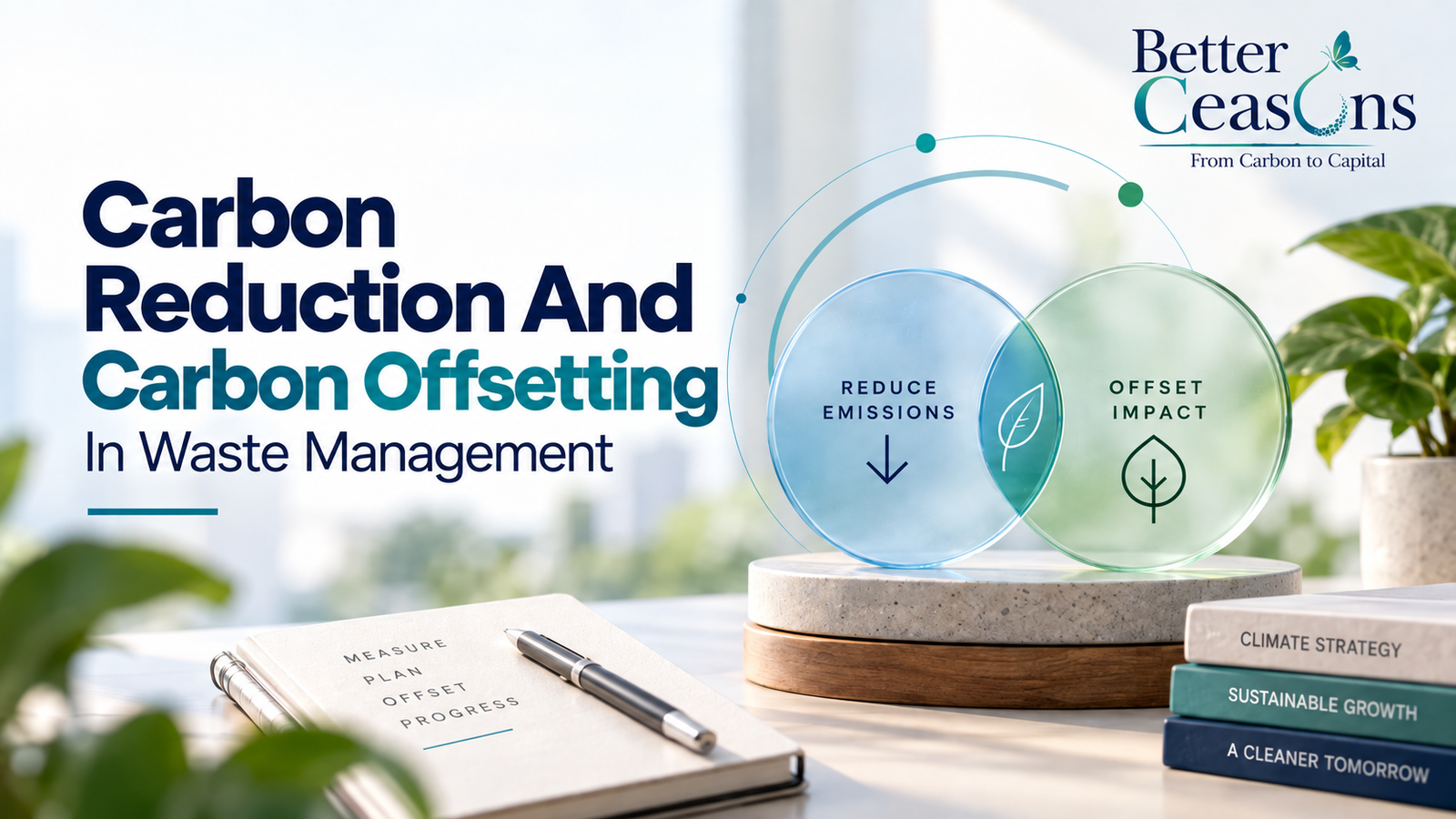
Carbon reduction and carbon offsetting are not the same. Carbon reduction directly lowers greenhouse gas emissions from an activity, while carbon offsetting compensates for remaining emissions through verified climate projects elsewhere. In waste management, businesses should prioritise reducing avoidable emissions from waste generation, transportation and treatment before relying on offsets.
Quick Answer
Carbon reduction and carbon offsetting are not the same. Carbon reduction directly lowers greenhouse gas emissions from an activity, while carbon offsetting compensates for remaining emissions through verified climate projects elsewhere. In waste management, businesses should prioritise reducing avoidable emissions from waste generation, transportation and treatment before relying on offsets.
Why the Difference Matters
Carbon terminology can become confusing.
A business may reduce its emissions, purchase carbon credits or do both.
But these actions should not be treated as interchangeable.
Understanding the difference helps businesses build more credible sustainability strategies.
What Is Carbon Reduction?
Carbon reduction means preventing or lowering emissions at the source.
In waste management, this may involve:
reducing unnecessary materials
improving reuse
cutting inefficient transport
reducing contamination
improving energy efficiency
choosing suitable treatment
These actions change the underlying activity that creates emissions.
What Is Carbon Offsetting?
Carbon offsetting works differently.
Instead of directly changing the original activity, an organisation supports an external project intended to avoid, reduce or remove greenhouse gases.
This is sometimes described as carbon compensation.
The important distinction is that the original emission may still occur.
The offset addresses its climate impact elsewhere.
Why Reduction Should Come First
Imagine a company sends half-full waste vehicles on long journeys every day.
It could purchase offsets for those emissions.
But the inefficient routes would still exist.
A stronger approach would first examine whether collection schedules, routes or vehicle utilisation could be improved.
Only the emissions that remain after practical reductions should enter the wider offsetting conversation.
Waste Has More Than One Carbon Source
The Better Ceasons Carbon perspective encourages people to look at the wider relationship between material and climate impact.
Waste-related emissions can arise through:
transportation
treatment energy
disposal
degradation of certain wastes
processing
material replacement
That means carbon management needs to follow the full waste journey.
Reduction Through Waste Prevention
One of the simplest forms of emissions reduction can happen before waste is created.
If a business reduces unnecessary packaging or production losses, it may avoid emissions associated with producing, transporting and treating that material.
Waste prevention therefore belongs in carbon planning.
Reduction Through Better Logistics
Transport is another practical area.
Businesses can examine:
pickup frequency
route length
vehicle utilisation
processing distance
intermediate facilities
Improving logistics can reduce fuel use while also lowering operational costs.
Reduction Through Appropriate Treatment
Different materials need different pathways.
If a clean recyclable material is sent to disposal unnecessarily, an opportunity may be lost.
If a highly contaminated material is transported long distances to an unsuitable processor and then rejected, emissions may be created with little benefit.
Understanding material composition helps select better treatment.
What About Waste Conversion?
Waste transformation can potentially recover value from suitable materials.
However, transformation should not automatically be counted as carbon reduction.
Energy use, transportation, material preparation, direct emissions and output utilisation all affect the result.
Better Ceasons discusses this nuance through Pyrolysis and Net Zero.
Where Carbon Offsetting Fits
A credible net zero strategy typically focuses first on deep emissions reductions.
However, certain residual emissions can be difficult to remove completely.
This is where high-quality carbon removals or verified credits may form part of the strategy.
The quality of the offset matters.
So does transparency around what is being offset.
Offsetting should not hide avoidable emissions.
Avoid Double Counting
Businesses should also ensure that environmental claims are not counted twice.
For example, one organisation should not claim the same reduction that another organisation has already claimed under a verified carbon mechanism without appropriate accounting.
Clear reporting protects credibility.
Measure Before Making Claims
Before describing waste operations as carbon neutral, organisations need robust data.
Useful information may include:
baseline emissions
waste quantities
transport activity
energy use
changes achieved through reduction
residual emissions
offsets purchased
This creates a traceable story.
Reduction and Offsetting Can Work Together
The distinction does not mean offsetting has no role.
It means the order matters.
A responsible sequence looks more like:
Measure.
Avoid.
Reduce.
Improve.
Calculate what remains.
Address residual emissions appropriately.
That creates a stronger climate strategy than buying offsets without changing inefficient operations.
Conclusion
Understanding carbon reduction and carbon offsetting protects businesses from treating two different climate actions as the same thing.
Reduction changes the source.
Offsetting deals with part of the remaining impact elsewhere.
In waste management, businesses should focus first on reducing unnecessary material, transport and treatment emissions.
Only after those opportunities have been addressed should compensation become part of the wider carbon conversation.
How Businesses Can Approach Carbon Reduction and Carbon Offsetting in Waste Management
A practical sequence for businesses to reduce waste-related emissions before considering carbon offsetting for residual emissions.
Measure waste-related emissions
Establish a baseline by reviewing waste quantities, transportation activity, energy use, treatment processes and other relevant sources of greenhouse gas emissions.
Avoid unnecessary waste
Identify opportunities to prevent waste before it is created, such as reducing unnecessary packaging, material losses and avoidable production waste.
Reduce emissions at the source
Lower direct emissions through better reuse, improved energy efficiency, reduced contamination and more efficient material management.
Improve waste logistics and treatment
Review collection frequency, route length, vehicle utilisation, processing distance and treatment suitability to reduce avoidable operational emissions.
Calculate residual emissions
After practical emissions reductions have been implemented, calculate the emissions that remain and cannot currently be eliminated.
Address residual emissions appropriately
Consider high-quality carbon removals or verified carbon credits for appropriate residual emissions while maintaining transparent accounting and avoiding double counting.
Track and report progress
Maintain records of baseline emissions, reductions achieved, residual emissions and any offsets or removals used so that environmental claims remain traceable.
Key Questions Answered
What is the difference between carbon reduction and carbon offsetting?↓
Carbon reduction directly lowers emissions, while offsetting compensates for remaining emissions through climate projects elsewhere.
Should businesses offset waste emissions?↓
Offsets may be relevant for residual emissions, but direct emissions reductions should generally be prioritised.
Can better waste transport reduce carbon emissions?↓
Yes. Better routing, vehicle utilisation and collection frequency can reduce unnecessary fuel use.
Does recycling always count as carbon reduction?↓
Not automatically. The total environmental benefit depends on transport, processing and what the recovered material replaces.
Is pyrolysis carbon neutral?↓
Not automatically. The complete process and lifecycle need to be assessed before making carbon-neutral claims.
Written by Team Better Ceasons
Better Ceasons Editorial Team
Better Ceasons is a clean-technology enterprise transforming municipal solid waste streams into high-value carbon resources and renewable energy.
Explore Clean Tech Solutions
Better Ceasons has developed a solution that converts suitable plastic waste into fuel, supporting responsible resource recovery.
Contact Better Ceasons