01
Pidilite Industries

Madhukar Parekh
Co-Founder
 ×
×
A story of Better Ceasons and the Institute of Chemical Technology (ICT), a nine-decade-old institution and a new-wave biotech company coming together to redefine how India handles its waste, its energy, and its future.
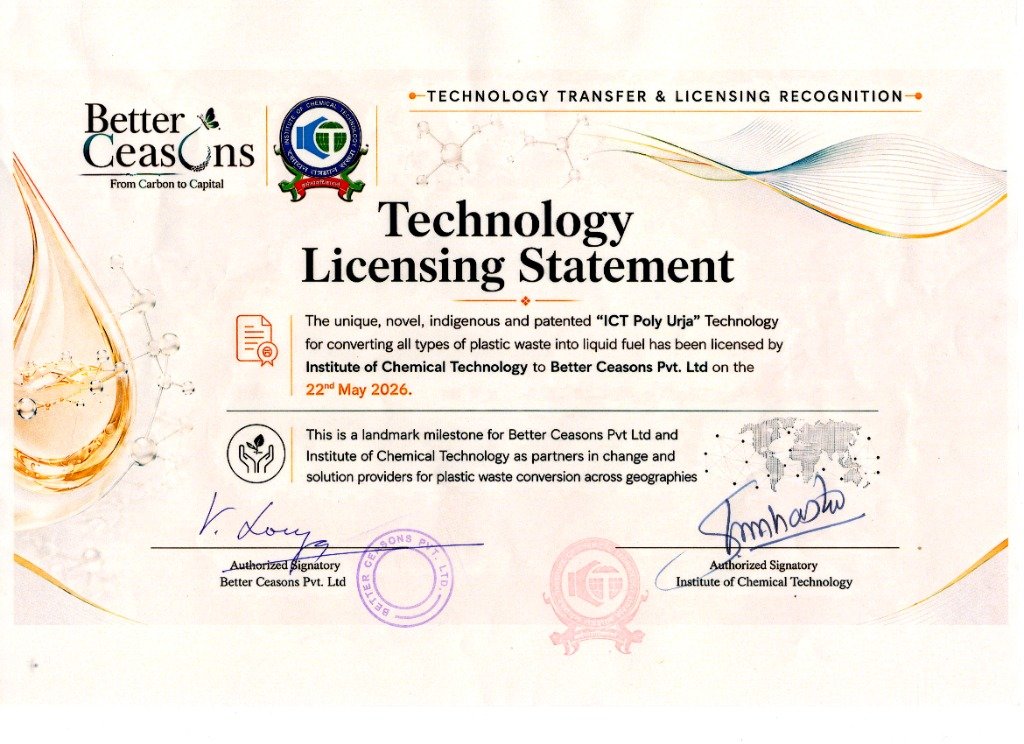
Technology Licensing Statement · 22 May 2026
8%
of India's GDP attributed to ICT alumni
The Roll Call
Institute of Chemical Technology
Madhukar Parekh
Co-Founder

Mukesh Dhirubhai Ambani
Chairman & Builder

Ashwin S. Dani
Key Leadership

Prafulla Chhajed
Leadership

Kallam Anji Reddy
Founder

Nilesh Gupta
Leadership

Ajay Piramal
Founder

Ramesh Chauhan
Chairman & Builder

Indravadan Modi
Founder

Pramod Chaudhari
Founder
The Partnership
Hence, we at Better Ceasons, decided to take our technology and partner with one of the leading Bio Technology development experts in the country.
The Institute of Chemical Technology stands as one of India's most respected institutions in chemical engineering, pharmaceuticals, and allied sciences, with roots tracing back to 1933. Over decades, it has built a reputation for rigorous academics, deep industry integration, and a research-driven culture that has directly shaped India's chemical, pharmaceutical, and manufacturing sectors.
What ICT brings to the partnership
A Deemed University whose platforms in Bio-Technology provide bridges for new wave start-ups to explore global opportunities in deep-tech.
ICT's areas of strength
Dedicated to industrial collaboration.
Premier reputation in Biotechnology, largely driven by its unique "bioprocess" approach which bridges pure biology with industrial engineering.
Widely considered one of the top institutions in India for specialised biotech research.
The impact is defined by its ability to move research from the lab to the factory floor.
ICT is accomplished in technology transfer, with developments in hydrogen production and waste-to-energy successfully scaled and integrated with companies like ONGC and BCPL respectively.
DBT-ICT Centre for Energy Biosciences is India's first centre dedicated to bio-energy and bio-fuels.
A global leader in 2G-Ethanol technology, which has been commercialised with major oil companies like HPCL.
ICT Biological Sciences & Biotechnology
The department's impact is defined by its ability to move research from the lab to the factory level — and to help industry create and execute solutions to the most intricate waste-to-energy problems.
The most recent venture is the joint development initiative with BCPL for transforming the landscape of waste management across geographies and across platforms using bio science.
The department's impact is defined by its ability to move research from the lab to the factory level and to help industry create and execute solutions to solve the most intricate waste to energy problems.
ICT's Biotechnology division stands out for its specialised focus on bio-industrial applications and commercialised technology.
ICT is now a world authority in Bioprocess Technology, Biofuels and Industrial Biotechnology.
Research & partnership
Good ideas become meaningful when they are tested, questioned, improved and given the opportunity to move beyond the lab.
Waste-to-energy research is not only about discovering what may be possible.
It is also about understanding whether an idea can work responsibly outside a controlled research environment.
For Better Ceasons, collaboration plays an important role in that journey.
Questions & answers
Waste-to-energy research explores how suitable waste streams may be used to recover energy or other useful value.
Research helps determine what works, what does not and what needs further improvement.
Waste-to-energy innovation means finding better or different ways to recover useful value from suitable waste streams.
Innovation may involve new ideas, new combinations of approaches or improvements to existing systems.
Waste-to-energy innovation ka matlab sirf nayi machine banana nahi hota.
Iska matlab waste ko better understand karke aise naye approaches explore karna bhi hai jo useful value recover karne mein help kar sakein.
Clean technology research explores ideas that aim to use resources more responsibly and reduce unnecessary environmental impact.
Simple terms mein, clean technology research better systems aur better solutions explore karta hai — especially aise solutions jo resources ko smarter way mein use karein aur unnecessary impact ko reduce karne ki direction mein kaam karein.
Lab-to-market describes the journey of taking an idea that has been researched or tested and gradually exploring whether it can work in practical, real-world conditions.
Pehle idea research aur testing se guzarta hai.
Uske baad larger conditions mein usko understand kiya jata hai, improve kiya jata hai aur different partners ke saath evaluate kiya ja sakta hai.
Successful scale-up usually ek step mein nahi hota.
Partnerships bring together different kinds of knowledge and experience.
They can help test ideas more realistically, identify problems earlier and create a stronger path from research toward practical use.