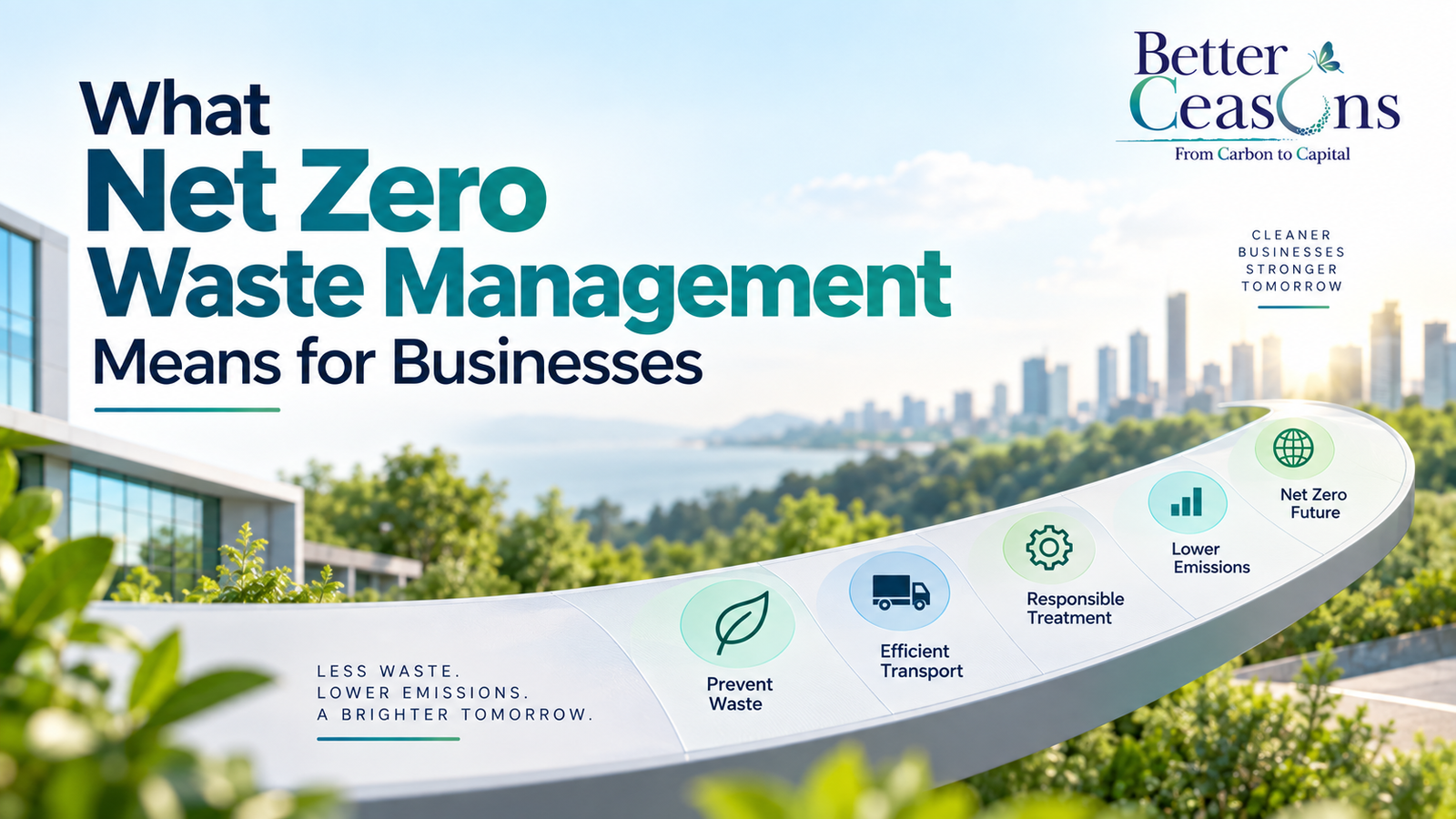
Net zero waste management means reducing greenhouse gas emissions associated with waste as far as reasonably possible and addressing residual emissions as part of a wider net-zero strategy. It requires businesses to consider waste generation, transport, processing, recovery and disposal rather than focusing only on how much material is diverted from landfill.
Waste Is Part of the Carbon Conversation
When businesses think about net zero, attention usually goes first to electricity, buildings, transportation and supply chains. Waste can also create emissions. Its carbon impact may arise during:- material production
- collection
- transportation
- sorting
- treatment
- disposal
- energy use
What Does Net Zero Actually Mean?
Net zero does not mean that no emissions occur anywhere. The objective is to reduce greenhouse gas emissions deeply and deal appropriately with the smaller amount that remains. Applied to waste, this means businesses should first identify and reduce avoidable waste emissions. Carbon offsetting should not become a shortcut around inefficient operations.1. Start With Waste Prevention
The strongest waste-related emission reduction often begins before material becomes waste. Businesses can examine:- packaging
- procurement
- production losses
- damaged goods
- disposable items
- inventory waste
- unnecessary printing
2. Understand What Your Business Generates
A net-zero approach requires data. Businesses should know:- what materials they generate
- how much is produced
- when it is generated
- where it is stored
- how often it is collected
- where it is treated
3. Reduce Unnecessary Transportation
Waste transport can become a hidden emissions source. Frequent small collections, long routes and multiple transfer points can increase fuel consumption. Improving scheduling and vehicle utilisation can support low-carbon operations. Businesses should also ask whether material is travelling through unnecessary intermediaries.4. Protect Recoverable Material
Contamination can reduce recovery potential. If cardboard becomes wet or plastic becomes mixed with food, additional treatment may be needed. Better storage and simple segregation can prevent avoidable loss of material value. However, segregation should be connected with real downstream infrastructure. Better Ceasons explains this distinction through Segregation The Urban Myth.5. Choose Appropriate Treatment
A net-zero strategy should not promote one treatment method for every material. Paper, metal, food, glass and different plastics all have different properties. Some streams are suitable for conventional recycling. Others require different forms of recovery. The right treatment depends on composition, contamination, location and available infrastructure.6. Look Beyond Landfill Diversion
Landfill diversion is often treated as the main waste-performance metric. It can be useful, but it does not tell the complete environmental story. A material may be diverted from landfill while travelling hundreds of kilometres to an inefficient process. Another material may enter a recovery route that creates genuinely useful output. Net-zero thinking therefore requires evaluating the full pathway.7. Understand the Role of Waste Transformation
For suitable difficult waste streams, transformation technologies may create additional recovery options. Better Ceasons discusses one such pathway through Pyrolysis and Net Zero. Importantly, transforming waste does not automatically make a process net zero. Energy input, feedstock preparation, transport, process emissions and final output use all matter.8. Measure Before Making Claims
Businesses should be cautious about describing their waste operations as carbon neutral without sufficient evidence. A credible net zero waste management strategy requires measurement. Useful indicators can include:- waste generated
- material avoided
- recovery rate
- transport distance
- treatment route
- energy consumption
- residual disposal
- emissions where measurable
9. Connect Waste With the Wider Net Zero Strategy
Waste should not sit in isolation from the rest of the organisation. Procurement affects material entering the business. Product design affects recoverability. Logistics affects transportation. Operations affect waste volumes. Sustainability teams can connect this information with the wider emissions inventory. That integration makes waste part of a real net zero strategy rather than a separate housekeeping exercise.Better Waste Thinking Supports Better Carbon Thinking
Better Ceasons explores the idea that waste does not simply disappear through The Waste Illusion. This idea is particularly relevant to net zero. Moving material outside the business boundary does not necessarily remove its climate impact. Understanding what happens next is essential.Conclusion
Net zero waste management is not about finding a zero-emission bin. It is about making a series of better decisions. Prevent unnecessary material. Protect recovery value. Move waste efficiently. Use suitable treatment. Measure the outcome. Reduce emissions before compensating for what remains. That is how waste can become part of a credible business climate strategy.How to Build a Net Zero Waste Management Approach
A practical framework for businesses to reduce waste-related emissions by preventing waste, improving material management, reducing transportation and measuring environmental outcomes.
Start with waste prevention
Review packaging, procurement, production losses, damaged goods, disposable items, inventory waste and unnecessary material use to prevent avoidable waste.
Understand what the business generates
Measure the types and quantities of materials generated, when they arise, where they are stored, how frequently they are collected and where they are treated.
Reduce unnecessary transportation
Review collection frequency, vehicle utilisation, transport distance and unnecessary transfer points to reduce avoidable waste transportation.
Protect recoverable material
Use appropriate storage and segregation practices to prevent recoverable materials from becoming unnecessarily contaminated or damaged.
Choose appropriate treatment
Select treatment or recovery pathways according to the composition, condition and characteristics of each material rather than applying one method to every waste stream.
Look beyond landfill diversion
Evaluate the complete environmental pathway, including transportation, processing requirements, recovery outcomes and useful outputs rather than relying only on landfill diversion rates.
Evaluate waste transformation
For suitable difficult waste streams, assess transformation or specialised recovery technologies while considering feedstock, energy use, transportation, emissions and final output use.
Measure before making claims
Track waste generated, material avoided, recovery rates, transport distance, treatment routes, energy consumption and residual disposal before making environmental claims.
Connect waste with the wider net zero strategy
Integrate waste information with procurement, product design, logistics, operations and sustainability planning so waste-related emissions become part of the wider organisational strategy.
Key Questions Answered
What is net zero waste management?↓
It means reducing greenhouse gas emissions associated with waste and managing remaining emissions as part of a broader net-zero strategy.
Is zero waste the same as net zero waste management?↓
No. Zero waste focuses mainly on material flows, while net zero focuses on greenhouse gas emissions.
Can recycling help a business achieve net zero?↓
It can contribute when recycling creates a lower-impact pathway for suitable materials, but the full lifecycle should be considered.
Is pyrolysis automatically net zero?↓
No. The full environmental impact, including energy, transportation and output use, needs to be evaluated.
What should businesses measure?↓
Businesses can track waste quantity, material type, destination, treatment route, transportation and recovery outcomes.
Written by Team Better Ceasons
Better Ceasons Editorial Team
Better Ceasons is a clean-technology enterprise transforming municipal solid waste streams into high-value carbon resources and renewable energy.
Explore Clean Tech Solutions
Better Ceasons has developed a solution that converts suitable plastic waste into fuel, supporting responsible resource recovery.
Contact Better Ceasons