
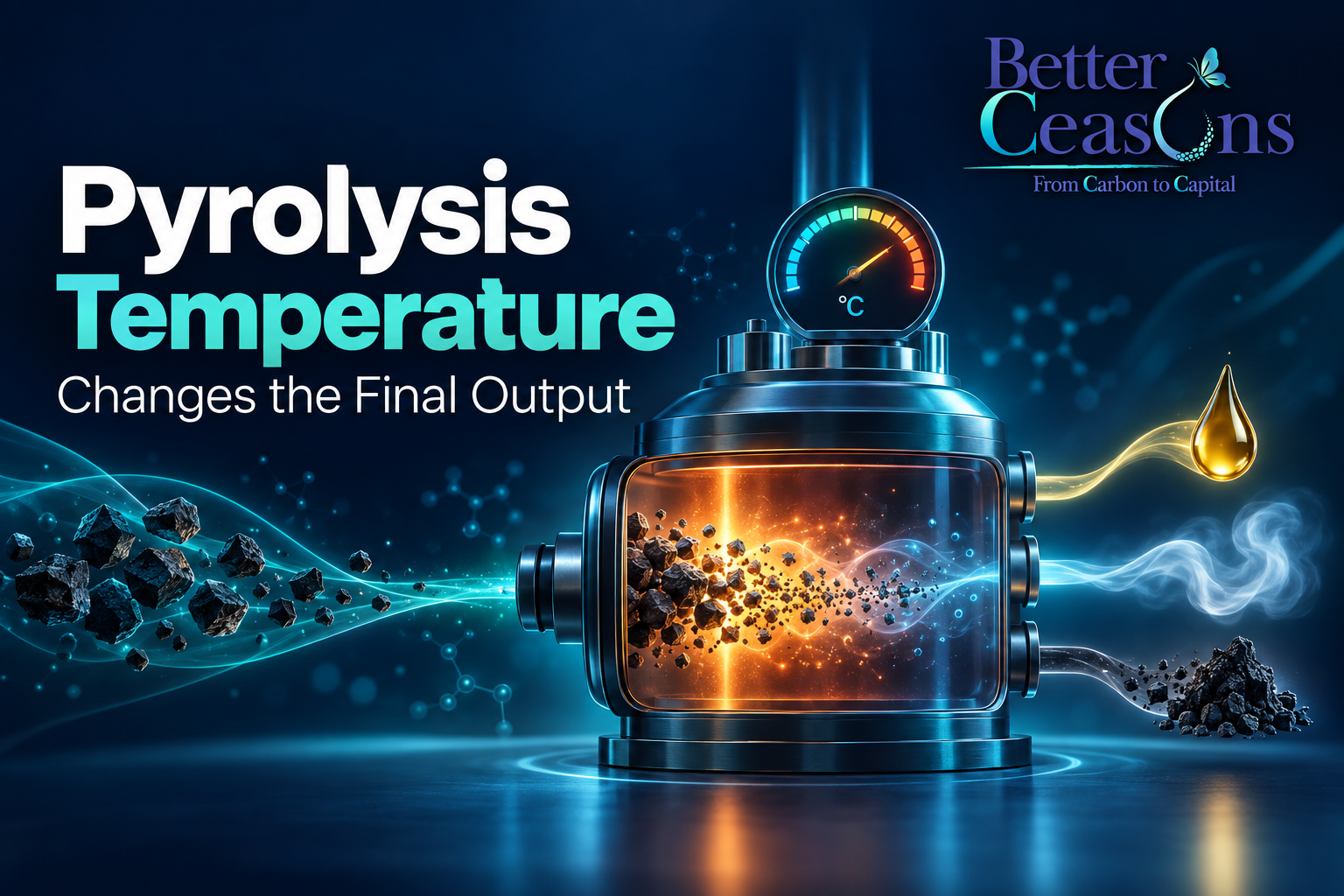
Pyrolysis temperature affects how a suitable feedstock breaks down during controlled heating and can influence the relative amounts and characteristics of solid, liquid and gaseous outputs. Temperature is important, but it works together with feedstock composition, heating rate, residence time, moisture, reactor design and other pyrolysis conditions.
Pyrolysis Is a Controlled Process
Pyrolysis is commonly described as the thermal decomposition of suitable material under conditions where oxygen is absent or strongly limited. That explanation is useful, but pyrolysis should not be understood as simply “heating waste.” The process involves carefully managed conditions. The material entering the reactor matters. The temperature matters. How quickly that temperature changes matters. How long the material remains inside the system matters. These variables influence how the feedstock transforms. Better Ceasons explores the broader idea of controlled thermal transformation through Pyrolysis and Net Zero.Why Does Pyrolysis Temperature Matter?
When suitable carbon-containing material is heated, its molecular structures begin to change. As the process temperature increases, different reactions can become more significant. This may affect:- the extent of decomposition
- the speed of reactions
- the amount of volatile material released
- the remaining solid fraction
- the composition of vapours
- the quantity of permanent gases
Feedstock Determines How Heat Behaves
Different materials respond differently to heat. A relatively consistent plastic stream may behave differently from mixed plastic. Biomass behaves differently from synthetic polymers. Even plastics within the same broad category can contain additives, coatings, fillers or contamination that influence their behaviour. This means pyrolysis temperature should always be understood in relation to the feedstock. A reactor cannot create predictable results if the material entering it changes dramatically from one batch to the next.Higher Temperature Does Not Automatically Mean Better Results
It is easy to assume that more heat means better conversion. That is not necessarily true. Higher temperatures require more energy. They may also shift the product distribution toward outputs that are not the intended objective. A process seeking a particular liquid fraction may require different operating conditions from one designed around a solid carbon-rich product. The objective should therefore be the appropriate operating range rather than the highest possible temperature.Reactor Control Helps Maintain Stability
Good reactor control is essential for maintaining predictable conditions. If one part of the reactor is significantly hotter than another, the feedstock may not experience uniform treatment. Temperature fluctuations can also affect:- conversion consistency
- material residence time
- vapour generation
- output characteristics
- energy consumption
Temperature Works With Heating Rate
The rate at which a material reaches its target temperature can influence how it decomposes. Slow heating and rapid heating can create different reaction environments. This means two processes operating at the same final temperature may still produce different results if their heating rates are different. It is another reason why pyrolysis should be evaluated as a complete system.Residence Time Matters Too
Residence time refers to how long material or reaction products remain within particular parts of the process. Longer or shorter exposure to high temperature can influence secondary reactions. For example, vapours that remain in a hot environment for longer may continue breaking down. Therefore, pyrolysis conditions are interconnected. Temperature alone cannot explain every output.Moisture Can Change Energy Requirements
Wet feedstock can use part of the process energy simply to heat and evaporate water. That can affect thermal efficiency. This is one reason material preparation and moisture control can be important before processing. A stable feedstock helps create a more stable process.Temperature Can Influence Output Quality
The quantity of an output is only one part of its value. Output quality also matters. The composition and properties of liquid, gaseous or solid fractions can change with operating conditions. A process may generate more of one fraction at a particular temperature but produce an output that requires additional treatment. The right question is therefore not: “How much output did the reactor create?” It is: “What did the reactor create, at what energy cost, and can that output be used responsibly?”Temperature Also Affects Energy Consumption
Heating any material requires energy. As operating temperatures rise, the energy required to maintain those conditions can also increase. That has both economic and environmental implications. When pyrolysis is discussed alongside carbon reduction or net-zero goals, process energy cannot be ignored. Better Ceasons’ approach to Pyrolysis and Net Zero emphasises that transformation alone does not make a process net zero. The complete system matters.Understanding the Bigger Picture
The importance of pyrolysis temperature teaches an important lesson about waste conversion. There is no single button labelled “transform.” Material composition, preparation, reactor design, heating rate, temperature and residence time all work together. That is why Better Ceasons approaches waste as a material challenge rather than treating every waste stream as identical.How to Understand the Effect of Pyrolysis Temperature on Final Output
A practical framework for understanding how temperature and other pyrolysis conditions influence material breakdown and final output characteristics.
Understand the feedstock
Identify the material being processed because different plastics, biomass and mixed materials can respond differently to heat.
Evaluate the process temperature
Consider how the operating temperature may influence decomposition, volatile release, solid fractions, vapours and permanent gases.
Review reactor control
Check whether operating conditions can remain stable because temperature fluctuations may affect conversion consistency, energy use and output characteristics.
Consider the heating rate
Evaluate how quickly the material reaches its operating temperature because different heating rates can create different reaction environments.
Consider residence time
Review how long materials and reaction products remain exposed to operating conditions because residence time can influence secondary reactions.
Check feedstock moisture
Consider moisture levels because energy may be consumed heating and evaporating water before useful thermal transformation occurs.
Evaluate output quality
Assess the characteristics and potential use of solid, liquid and gaseous fractions rather than considering output quantity alone.
Assess total energy requirements
Consider the energy needed to achieve and maintain the required operating conditions when evaluating overall process performance.
Key Questions Answered
What temperature is used for pyrolysis?↓
There is no single temperature for all pyrolysis systems. The appropriate range depends on feedstock, reactor design and intended outputs.
Does higher pyrolysis temperature produce more fuel?↓
Not automatically. Higher temperatures can change product distribution, but the result depends on the feedstock and complete process.
Why is reactor temperature control important?↓
Stable temperature helps create more predictable reaction conditions and can improve consistency.
Can temperature affect pyrolysis oil quality?↓
Yes. Temperature and other process conditions can influence the composition and characteristics of liquid fractions.
Is temperature the most important factor in pyrolysis?↓
It is important, but feedstock, heating rate, residence time, moisture and reactor design also influence the outcome.
Written by Team Better Ceasons
Better Ceasons Editorial Team
Better Ceasons is a clean-technology enterprise transforming municipal solid waste streams into high-value carbon resources and renewable energy.
Explore Clean Tech Solutions
Better Ceasons has developed a solution that converts suitable plastic waste into fuel, supporting responsible resource recovery.
Contact Better Ceasons