
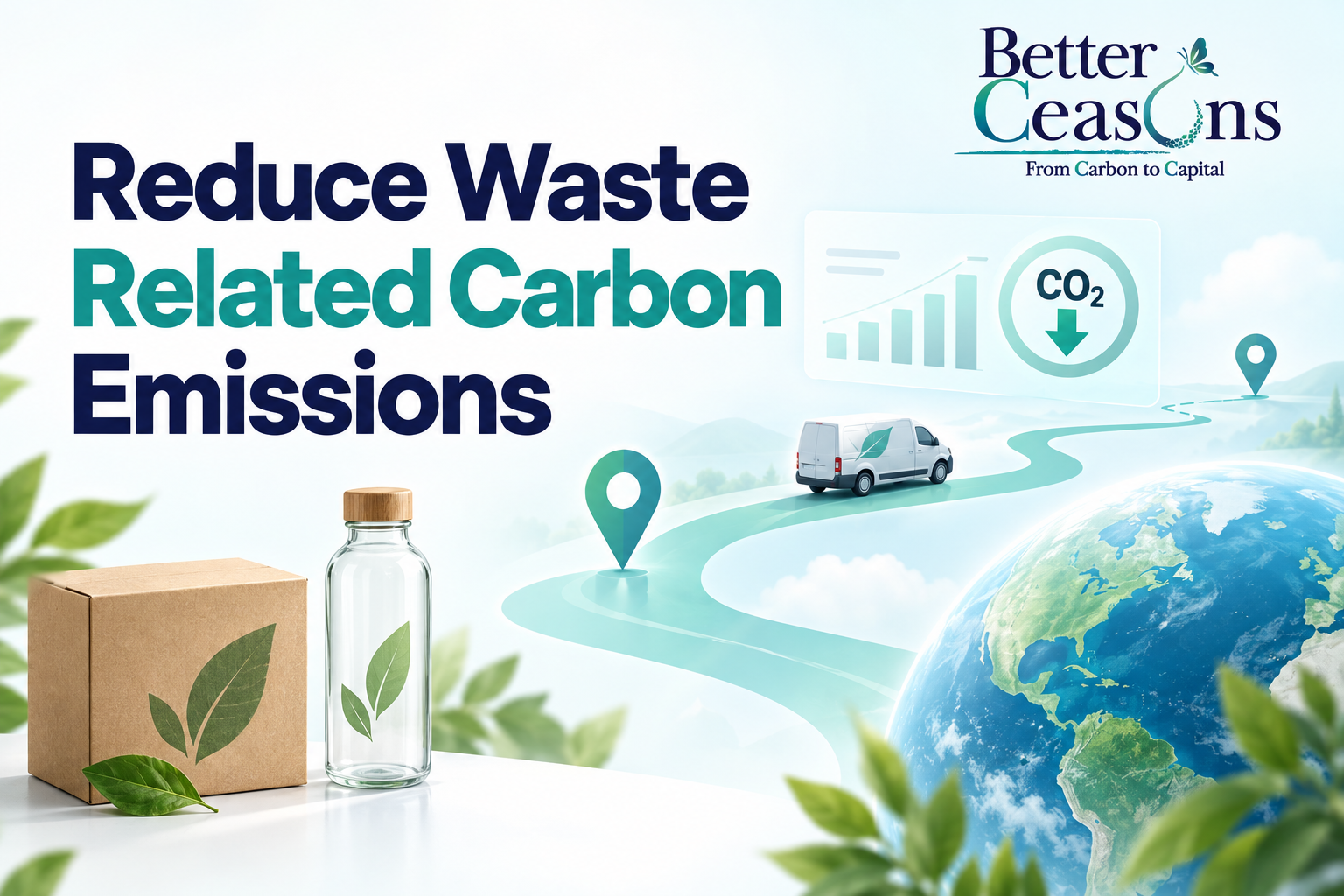
Businesses can reduce waste related carbon emissions by preventing unnecessary waste, keeping recoverable materials cleaner, improving collection routes, reducing unnecessary transportation and choosing treatment methods based on the material itself. Waste-related carbon impact can occur during collection, transportation, sorting, processing and final treatment, so businesses need to look at the complete journey rather than disposal alone.
Waste Has a Carbon Journey
When a collection vehicle removes waste from a business, the waste may disappear from view, but its environmental impact continues. Vehicles need energy to move it. Transfer stations and sorting facilities require infrastructure. Materials may travel to different processors before reaching their final destination. Treatment itself can consume electricity, heat or fuel. This means waste management and carbon management are increasingly connected. Better Ceasons explores this relationship through its Carbon page, which encourages a broader understanding of waste, emissions and climate responsibility. Businesses that want to lower their environmental impact should therefore look beyond the amount of waste they produce and understand what happens after collection.1. Prevent Unnecessary Waste First
The most direct way to reduce emissions associated with a material is often to avoid creating unnecessary material in the first place. Businesses can review procurement, packaging and operational processes to identify waste that adds little functional value. Opportunities may include:- reducing excessive secondary packaging
- eliminating unnecessary disposable items
- improving inventory management
- preventing product damage
- introducing reusable transport packaging
- reducing production offcuts
- improving purchasing quantities
2. Improve Segregation Where It Helps Recovery
Keeping certain waste streams separate can improve their recovery potential. Clean cardboard mixed with wet food waste may become much harder to recover. Similarly, plastics contaminated with liquids, oil or soil may require additional cleaning and processing. Good segregation can help maintain material quality. However, segregation alone is not a complete solution. Better Ceasons explores this idea through Segregation The Urban Myth. The important question is not simply whether a material was sorted. It is whether the sorted material has a responsible next destination.3. Improve Route Efficiency
Waste transport can create significant operational emissions. Collection vehicles may travel long distances, operate in congested traffic or make repeated journeys with partially filled loads. Better route efficiency can help reduce unnecessary fuel consumption. Businesses and waste-management partners can examine:- pickup frequency
- vehicle utilisation
- route overlap
- collection timing
- distance to processing facilities
- unnecessary intermediate stops
- opportunities to consolidate loads
4. Reduce Contamination Before Collection
Contamination adds complexity. When recoverable materials become mixed with food residue, liquids, chemicals or unrelated waste, more processing may be required. That additional processing can involve water, electricity, labour and transportation. Simple operational practices can help. Businesses can provide clearly labelled collection areas, protect stored material from rain and train teams to avoid unnecessary mixing. Cleaner material is often easier to understand, transport and recover.5. Match Treatment to the Material
There is no single treatment method that is appropriate for every waste stream. Some materials may be suitable for reuse. Others can be mechanically recycled. Organic material may be more appropriate for biological pathways. Certain complex or difficult carbon-containing waste streams may require specialised processing. This is why Better Ceasons encourages people to look beyond disposal through The Waste Illusion. The goal should not be to find one machine for all waste. The goal should be to understand the material and identify the most responsible realistic pathway.6. Evaluate Low-Emission Treatment Carefully
A low-emission treatment method should not be judged by a label alone. Its actual impact depends on several factors:- feedstock
- energy requirement
- transportation
- preparation
- process efficiency
- emissions controls
- useful outputs
- residue management
7. Track the Operational Carbon Impact
Measurement allows businesses to move from assumptions to informed decisions. Useful waste information can include:- monthly material quantities
- types of waste generated
- pickup frequency
- distance travelled
- treatment destination
- recovery route
- rejected material
- final residual waste
8. Include Waste in Wider Sustainability Planning
Waste is sometimes treated only as a housekeeping responsibility. A more effective approach connects it with procurement, operations, logistics and sustainability. Procurement teams influence what enters the business. Operations influence how much is wasted. Facilities teams influence storage and segregation. Logistics decisions influence transportation. Waste partners influence downstream outcomes. When these functions work together, carbon reduction becomes more realistic.From Waste Management to Carbon Management
To reduce waste related carbon emissions, businesses need to look beyond the final bin. Waste has a journey. Every unnecessary material, extra vehicle movement, contamination issue and inefficient treatment step can influence the final impact. The better approach is not based on one miracle solution. It is a sequence of better decisions: Reduce what is unnecessary. Keep useful materials recoverable. Move them intelligently. Choose treatment based on composition. Recover value where appropriate. Measure the full journey. That reflects the wider Better Ceasons goal of changing the conversation from simply removing waste to understanding what happens next.How to Reduce Waste Related Carbon Emissions
Practical steps businesses can take to reduce carbon emissions associated with waste generation, collection, transportation, recovery and treatment.
Prevent unnecessary waste
Review procurement, packaging and operational processes to identify and reduce materials that add little functional value while maintaining necessary product protection and performance.
Improve segregation
Keep appropriate waste streams separate so recoverable materials remain cleaner and have a better chance of reaching suitable recovery pathways.
Improve route efficiency
Review pickup frequency, vehicle utilisation, route overlap, collection timing and distance to processing facilities to reduce unnecessary transportation.
Reduce contamination before collection
Use clearly labelled collection areas, protect stored material and train teams to prevent recoverable materials from becoming unnecessarily contaminated.
Match treatment to the material
Evaluate the characteristics of each waste stream and select suitable reuse, recycling, biological, recovery or specialised treatment pathways.
Evaluate low-emission treatment carefully
Assess feedstock, energy requirements, transportation, process efficiency, emissions controls, useful outputs and residue management before selecting a treatment method.
Track operational carbon impact
Measure waste quantities, collection frequency, transport distance, treatment destinations, recovery pathways, rejected material and residual waste.
Include waste in sustainability planning
Connect waste management decisions with procurement, operations, facilities, logistics and wider sustainability planning.
Key Questions Answered
How can businesses reduce waste related carbon emissions?↓
Businesses can reduce waste-related emissions by preventing unnecessary waste, improving transport efficiency, reducing contamination and choosing appropriate recovery or treatment pathways.
Does waste transportation affect carbon emissions?↓
Yes. Collection distance, vehicle type, traffic, route planning and vehicle utilisation can all influence transport-related emissions.
Is recycling always the lowest-carbon option?↓
Not necessarily. The total impact depends on the material, contamination, transportation distance, processing requirements and what the recovered material replaces.
Can better segregation reduce carbon emissions?↓
It can help when segregation improves material recovery and prevents unnecessary cleaning, sorting or disposal.
Why should companies measure their waste journey?↓
Measurement helps identify inefficient collections, long transport routes, contamination, and treatment stages where practical carbon reductions may be possible.
Written by Team Better Ceasons
Better Ceasons Editorial Team
Better Ceasons is a clean-technology enterprise transforming municipal solid waste streams into high-value carbon resources and renewable energy.
Explore Clean Tech Solutions
Better Ceasons has developed a solution that converts suitable plastic waste into fuel, supporting responsible resource recovery.
Contact Better Ceasons