
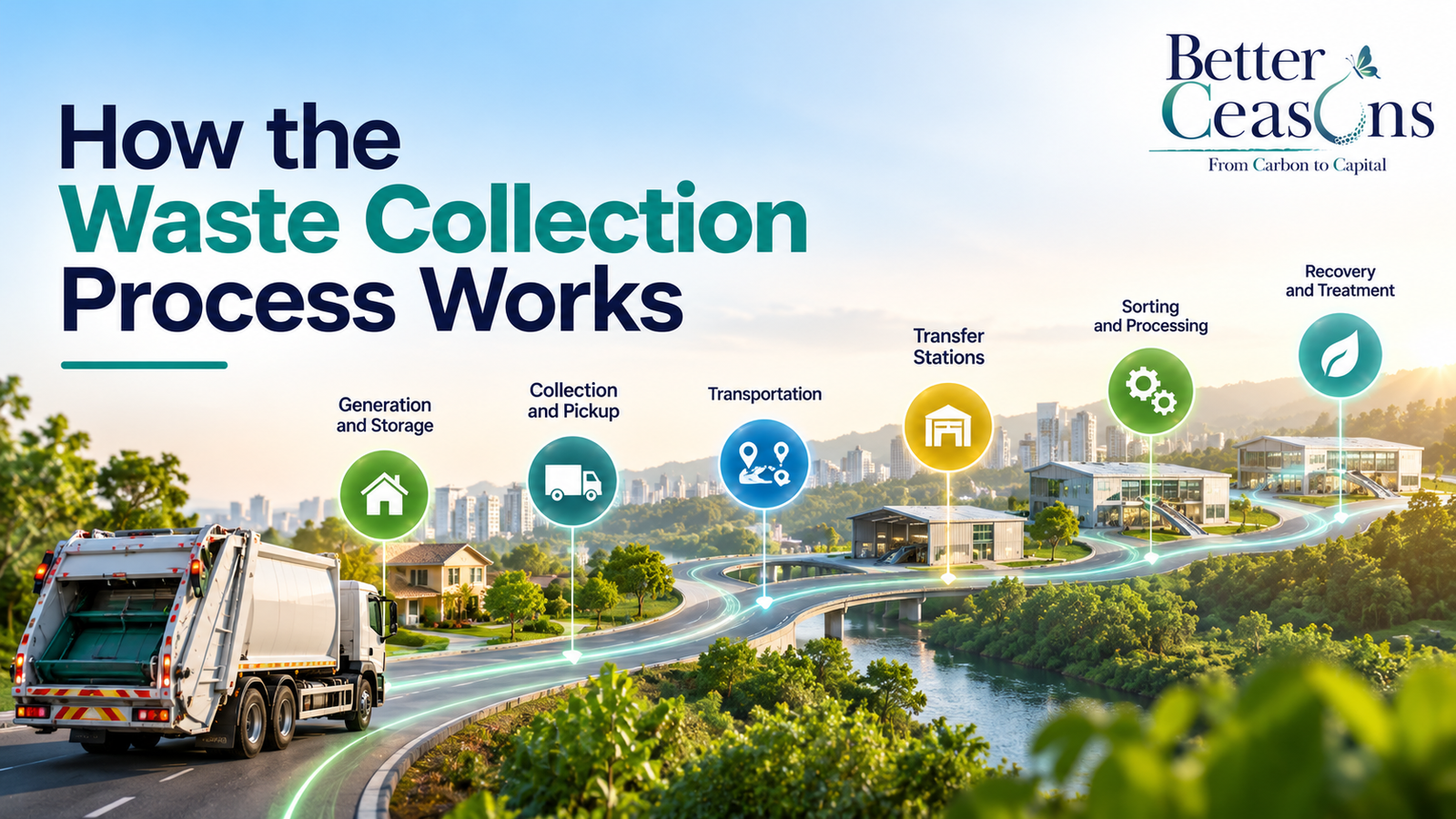
The waste collection process moves discarded material from homes, businesses and public spaces into a wider waste-management system. After pickup, waste may travel to transfer stations, sorting facilities, recycling centres, treatment plants or final disposal sites depending on the material and local infrastructure.
Quick Answer
The waste collection process moves discarded material from homes, businesses and public spaces into a wider waste-management system. After pickup, waste may travel to transfer stations, sorting facilities, recycling centres, treatment plants or final disposal sites depending on the material and local infrastructure.Collection Is Not the End
For most people, the waste journey ends when a bin is emptied. The material disappears from view. But collection is actually one of the earliest stages of waste management. The material still needs to be transported, understood and treated. This is the central idea behind Better Ceasons’ Waste Illusion. Waste does not disappear. It moves.Step 1: Waste Is Generated
Waste begins in many different places. These include:- households
- restaurants
- factories
- offices
- hospitals
- shops
- construction sites
- public areas
Step 2: Waste Is Stored
Before collection, material needs temporary storage. Depending on the waste stream, this might involve:- bins
- bags
- drums
- skips
- compactors
- dedicated storage rooms
Step 3: Waste Is Presented for Collection
Some waste is collected according to municipal schedules. Commercial and industrial generators may use contracted waste-management companies. Collection frequency depends on:- waste volume
- storage capacity
- hygiene requirements
- material type
- local regulations
Step 4: Collection Vehicles Pick Up the Waste
Different collection vehicles are designed for different situations. Some collect loose municipal waste. Others carry compacted material. Specialised vehicles may handle liquid or hazardous waste. The vehicle needs to match the material and the operating environment.Step 5: The Waste Is Transported
After pickup, the material may travel directly to a treatment facility. However, many systems use intermediate locations. Possible destinations include:- transfer stations
- aggregation centres
- sorting facilities
- recycling centres
- specialised processors
Step 6: Transfer Stations May Consolidate Loads
Small collection vehicles may bring waste to a larger transfer station. There, material can be consolidated into larger vehicles for longer-distance movement. This can improve transport efficiency. However, transfer stations are only useful when they form part of an efficient network.Step 7: Sorting May Take Place
Collected waste can contain several different materials. Sorting facilities may use:- manual separation
- screens
- magnets
- optical sensors
- air systems
- automated equipment
Step 8: Different Materials Follow Different Routes
After sorting, materials may enter:- reuse systems
- recycling
- biological treatment
- specialised processing
- energy recovery
- final disposal
What Happens After Collection?
The phrase what happens after collection is more important than it may appear. A city can have excellent collection while still having poor treatment. Clean streets do not prove that collected material is being recovered responsibly. Collection and waste-management success are not identical.Collection Has a Carbon Impact
Vehicles consume energy. Routes create emissions. Transfer facilities need power. Repeated handling adds movement. This is why waste management should consider logistics alongside treatment.Waste Data Can Improve Collection
Modern systems increasingly use data to improve:- collection frequency
- route planning
- vehicle utilisation
- bin capacity
- driver efficiency
Businesses Should Understand Their Collection System
Commercial generators should ask: How often is waste collected? Where does it go? Does it travel through a transfer station? How far is the treatment facility? What happens to rejected material? These questions help create accountability.Final Thought
The waste collection process is essential, but it is only the beginning. Pickup moves the material away from where it was generated. Sorting, recovery, treatment and final management determine what happens next. Once people understand this invisible journey, waste stops being a simple bin problem and becomes a larger material-management challenge.How the Waste Collection Process Works
A step-by-step overview of how waste moves from generation and storage through pickup, transportation, sorting, recovery and final treatment.
Waste is generated
Waste is generated by households, restaurants, offices, factories, hospitals, shops, construction sites and public areas. The source influences the type and composition of the material.
Waste is stored
Waste is temporarily stored in bins, bags, drums, skips, compactors or dedicated storage areas before collection.
Waste is presented for collection
Waste is made available for pickup according to municipal schedules or commercial collection arrangements based on material type, volume, storage capacity and local requirements.
Collection vehicles pick up the waste
Appropriate collection vehicles pick up the waste. Different vehicle types may be used for loose waste, compacted material, liquid waste or specialised waste streams.
Waste is transported
Collected material is transported to destinations such as transfer stations, aggregation centres, sorting facilities, recycling centres or treatment plants.
Transfer stations may consolidate loads
Smaller collection loads may be consolidated into larger vehicles at transfer stations to improve longer-distance transportation efficiency.
Waste may be sorted
Sorting facilities may use manual separation, screens, magnets, optical sensors, air systems and automated equipment to separate different material types.
Materials follow different treatment routes
After sorting, materials may move into reuse, recycling, biological treatment, specialised processing, energy recovery or final disposal depending on their characteristics.
Key Questions Answered
What happens after waste collection?↓
Waste may move to transfer, sorting, recycling, treatment or final disposal facilities.
What is a waste transfer station?↓
It is a facility where smaller loads may be consolidated before longer-distance transportation.
Is waste collection the same as waste management?↓
No. Collection is only one stage of the wider system.
Do collection vehicles create emissions?↓
Yes. Fuel or energy used during collection and transportation contributes to the waste carbon footprint.
Why is waste sorting done after collection?↓
Sorting helps separate different materials so they can follow more appropriate treatment pathways.
Written by Team Better Ceasons
Better Ceasons Editorial Team
Better Ceasons is a clean-technology enterprise transforming municipal solid waste streams into high-value carbon resources and renewable energy.
Explore Clean Tech Solutions
Better Ceasons has developed a solution that converts suitable plastic waste into fuel, supporting responsible resource recovery.
Contact Better Ceasons