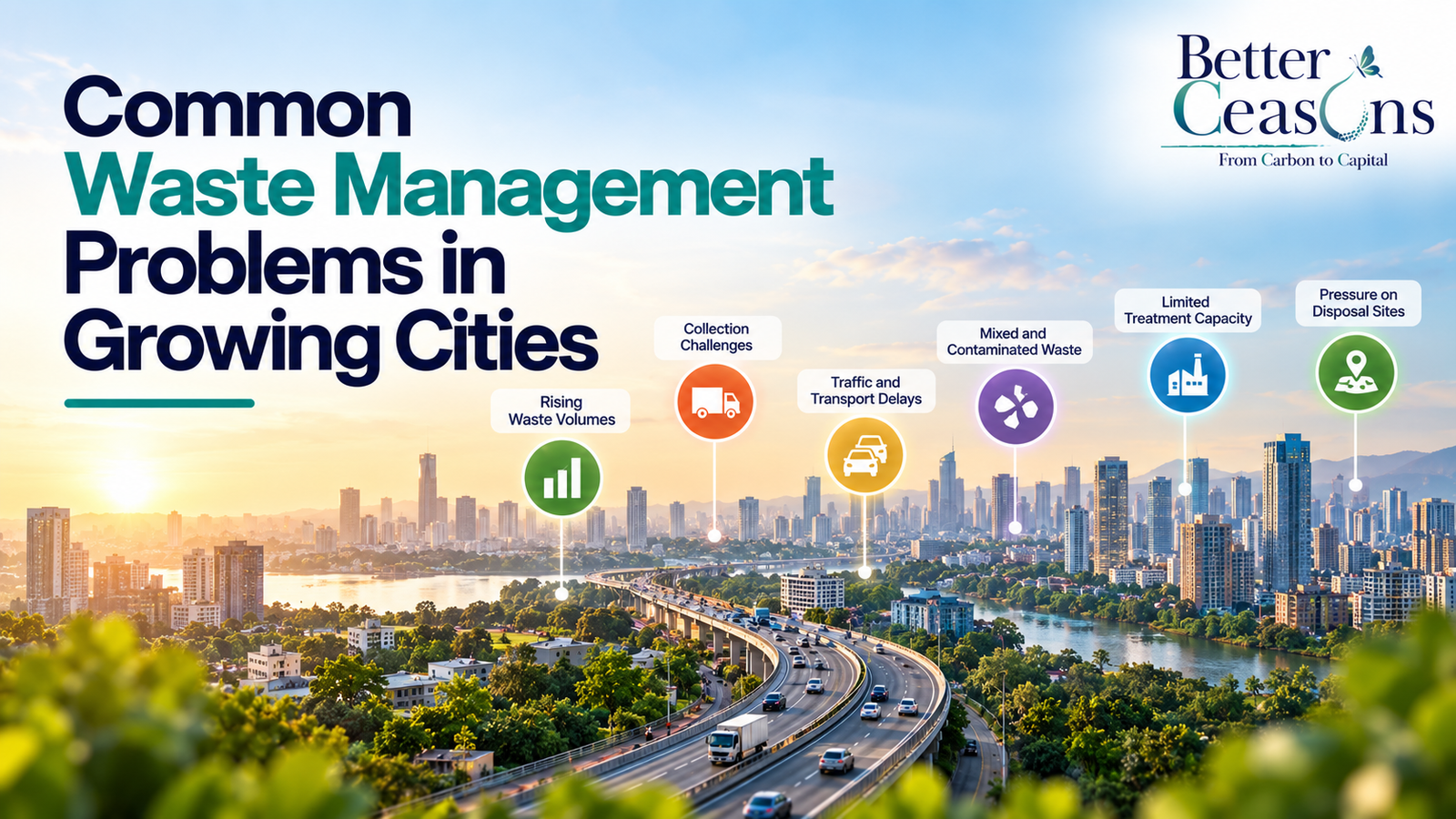
Common waste management problems in growing cities include rising waste volumes, incomplete collection, traffic-related transport delays, contamination, limited sorting infrastructure, insufficient treatment capacity and growing pressure on disposal sites. Solving these challenges requires connected systems rather than focusing only on collection.
Quick Answer
Common waste management problems in growing cities include rising waste volumes, incomplete collection, traffic-related transport delays, contamination, limited sorting infrastructure, insufficient treatment capacity and growing pressure on disposal sites. Solving these challenges requires connected systems rather than focusing only on collection.Urban Growth Changes Waste
Cities grow because they concentrate people, businesses and services. As population and economic activity increase, waste volumes generally increase too. But the challenge is not only quantity. The type of waste changes. Growing cities can generate more:- packaging
- food waste
- delivery materials
- multilayer plastic
- electronics
- commercial waste
- construction debris
Problem 1: Collection Systems Fall Behind
Rapidly expanding neighbourhoods can outgrow existing collection networks. Municipal systems may need:- more vehicles
- more staff
- new routes
- additional transfer stations
Problem 2: Traffic Makes Waste Movement Expensive
Waste vehicles operate on the same crowded streets as commuters and deliveries. Congestion increases:- travel time
- fuel use
- emissions
- operating cost
Problem 3: Mixed Waste Reduces Recovery
Highly mixed waste is harder to recover. Food can contaminate paper. Liquids can affect plastic. Glass can break. Once materials become heavily mixed, sorting becomes more expensive and some value may be lost.Problem 4: Segregation Systems Are Inconsistent
Cities often introduce multiple waste categories without ensuring that materials remain separate after collection. Residents may separate correctly, only to see materials mixed later. That can reduce public trust. Better Ceasons discusses the wider limitation of segregation through Segregation The Urban Myth.Problem 5: Treatment Capacity Does Not Match Collection
Collection is highly visible. Treatment is less visible. A city may successfully collect most of its waste while lacking enough treatment capacity to process it responsibly. This creates bottlenecks. Waste accumulates or shifts to disposal sites.Problem 6: Disposal Land Is Limited
Urban land is valuable. Cities need space for:- housing
- roads
- hospitals
- industry
- public infrastructure
Problem 7: Difficult Materials Need Better Infrastructure
Multilayer plastic, composite packaging and heavily contaminated waste may not fit conventional recovery systems easily. Cities need waste infrastructure that recognises these differences. One treatment facility cannot realistically solve every material problem.Problem 8: Waste Data Is Often Weak
Cities need reliable information about:- waste quantities
- material composition
- route performance
- treatment outcomes
- recovery rates
- residual waste
Problem 9: Informal and Formal Systems May Be Disconnected
In many cities, informal workers play an important role in collecting and recovering valuable materials. Waste systems can perform better when these activities are recognised and integrated safely rather than ignored.Problem 10: Public Awareness Stops at the Bin
People may be told to segregate waste but receive little information about what happens next. Better awareness should explain:- why contamination matters
- which materials are difficult
- what happens after collection
- why different treatment pathways exist
The Bigger Waste Illusion
Better Ceasons describes a wider problem through The Waste Illusion. Clean streets can create the impression that waste has been solved. In reality, collected material continues its journey somewhere else. Urban waste success should therefore be measured beyond visible cleanliness.Cities Need Integrated Systems
Growing cities need connected infrastructure for: Collection. Transfer. Sorting. Recycling. Biological treatment. Advanced processing. Resource recovery. Final residual disposal. Each part influences the next.Technology Can Help, but It Is Not Enough
Smart bins, AI sorting and automated routes can improve operations. But technology cannot solve problems created by missing treatment capacity or poor system design. Tools need to sit inside a coherent strategy.Final Thought
The biggest waste management problems in growing cities come from treating waste as a collection problem rather than a complete material system. Bins matter. Vehicles matter. But what happens after collection matters just as much. Cities that connect collection, treatment, recovery and resource planning will be better prepared for the waste volumes and material complexity of the future.How to Assess Waste Management Problems in Growing Cities
A practical process for identifying collection, transport, sorting, treatment and infrastructure gaps in growing urban waste systems.
Measure waste volumes
Track how much waste is generated across households, businesses, commercial areas and other urban sources.
Analyse material composition
Understand the proportion of packaging, food waste, plastics, electronics, construction debris and other materials in the urban waste stream.
Review collection performance
Assess collection coverage, frequency, staffing, vehicle availability and whether growing neighbourhoods are adequately served.
Evaluate transport efficiency
Review route distances, congestion, transfer stations, fuel use and the location of treatment facilities.
Check segregation and contamination
Identify whether separated materials remain separate after collection and measure how contamination affects recovery potential.
Compare treatment capacity with collected waste
Determine whether sorting, recycling, biological treatment, advanced processing and other facilities can handle the actual amount of collected waste.
Assess difficult material pathways
Review whether multilayer plastics, composites and heavily contaminated materials have suitable treatment or recovery options.
Review disposal capacity
Assess available disposal space, residual waste volumes and whether dependence on disposal sites is increasing.
Improve waste data quality
Track waste quantities, route performance, recovery rates, treatment outcomes and residual waste to support better planning.
Evaluate the waste system as a whole
Review collection, transport, sorting, treatment, recovery and final disposal together to identify where the main system bottlenecks occur.
Key Questions Answered
What are the main waste management problems in cities?↓
Common issues include rising waste volumes, incomplete collection, contamination, transport challenges and insufficient treatment capacity.
Why does urban growth increase waste challenges?↓
More people, businesses and consumption create larger and more complex waste streams.
Is better collection enough to solve waste problems?↓
No. Cities also need adequate sorting, treatment, recovery and final disposal capacity.
Why are multilayer plastics difficult for cities?↓
They can be difficult to separate and recycle through conventional systems.
How can data improve city waste management?↓
Reliable data helps cities plan routes, infrastructure and treatment capacity more accurately.
Written by Team Better Ceasons
Better Ceasons Editorial Team
Better Ceasons is a clean-technology enterprise transforming municipal solid waste streams into high-value carbon resources and renewable energy.
Explore Clean Tech Solutions
Better Ceasons has developed a solution that converts suitable plastic waste into fuel, supporting responsible resource recovery.
Contact Better Ceasons