
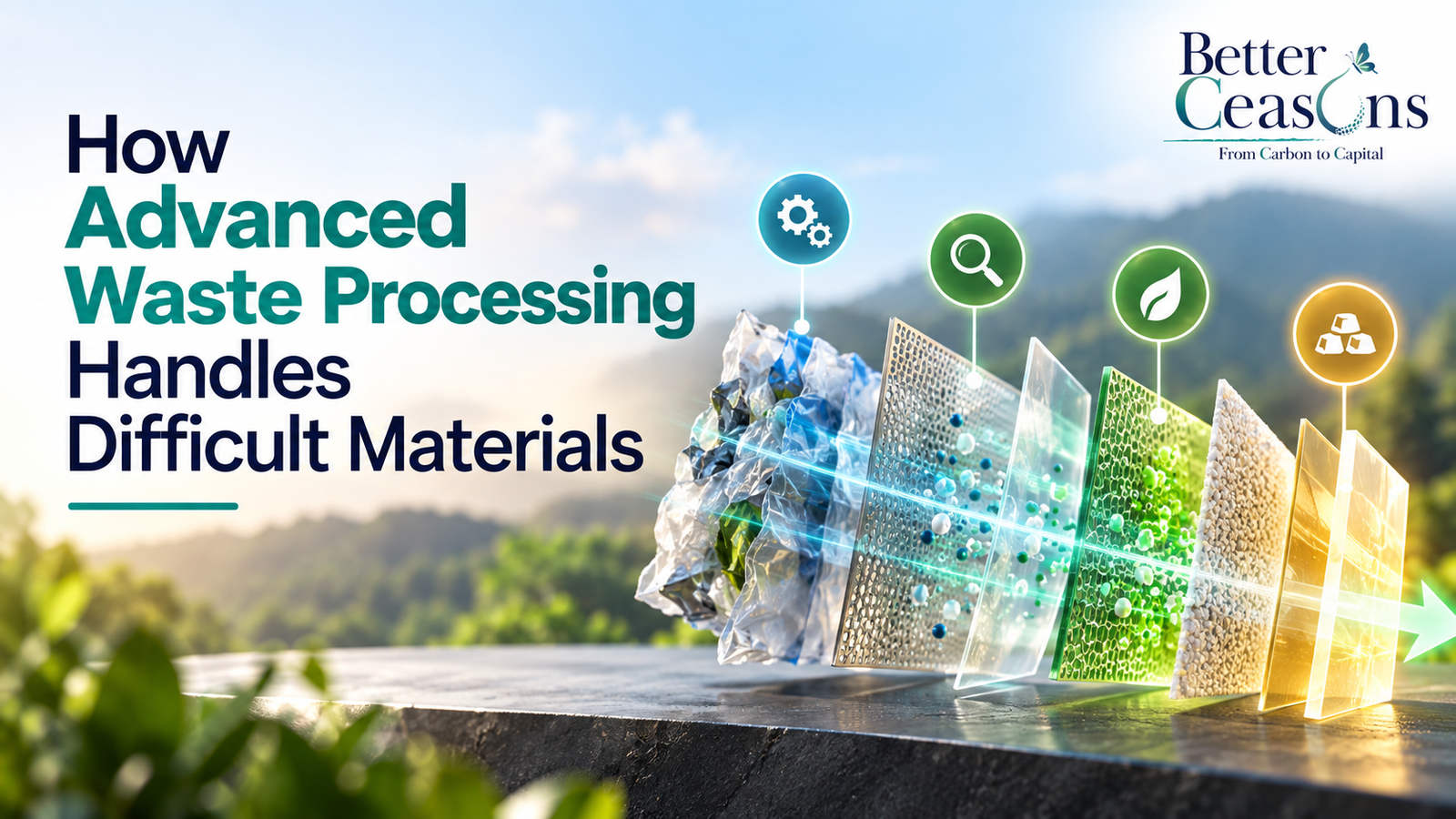
Advanced waste processing uses specialised mechanical, biological, chemical and thermal systems to manage waste streams that conventional recovery may struggle to handle. The appropriate technology depends on material composition, contamination, available recovery routes and the intended output.
Quick Answer
Advanced waste processing uses specialised mechanical, biological, chemical and thermal systems to manage waste streams that conventional recovery may struggle to handle. The appropriate technology depends on material composition, contamination, available recovery routes and the intended output.Why Some Waste Is Difficult
The simplest waste streams are usually consistent and easy to identify. Real-world waste is often neither. Materials can be:- mixed
- wet
- contaminated
- multilayered
- chemically complex
- physically bonded
- degraded
Advanced Does Not Mean One Technology
The term advanced waste processing covers a range of approaches. Depending on the material, these may include:- optical sorting
- automated separation
- specialised biological treatment
- chemical recovery
- thermal conversion
- sensor-based material identification
Better Sorting Can Improve Material Recovery
Modern processing systems increasingly use technology to recognise materials. Optical sensors can help identify different polymers. Magnets can recover ferrous metals. Eddy-current systems can help separate certain non-ferrous metals. Automation can reduce repetitive manual sorting. These technologies can improve material quality before treatment.Sorting Still Has Limits
Even highly advanced sorting cannot easily separate every product. A multilayer pouch may contain several materials bonded together within a structure thinner than a millimetre. Identifying the pouch does not automatically separate those layers. This is why Better Ceasons discusses the limitation of sorting through Segregation The Urban Myth.difficult plastic waste treatment May Require Transformation
When preserving the original material is not practical, difficult waste treatment may involve changing its physical or chemical form. This is where conversion technologies can play a role.Waste Conversion Technology Expands Options
Waste conversion technology may use biological, chemical or thermal processes to transform suitable waste. For carbon-containing material, controlled thermal approaches can potentially generate different fractions. Better Ceasons explores pyrolysis as one example through Pyrolysis and Net Zero.Feedstock Still Comes First
Advanced technology does not remove the need to understand the material. Operators still need information about:- composition
- contaminants
- moisture
- particle size
- hazardous components
Material Recovery Should Remain a Priority
A complicated process should not be selected simply because it is technologically impressive. If straightforward material recovery works, it may be the more practical option. Advanced processing is most useful when it solves a problem that simpler systems cannot handle effectively.Output Quality Matters
A waste process should not be judged only by how much material enters it. The output needs to be considered too. Questions include: Is the recovered material usable? Does it have consistent properties? Can it replace another resource? What happens to rejected fractions? A technology creates value only when outputs have responsible uses.Environmental Performance Matters
Advanced systems can consume significant energy. Some may require:- electricity
- heat
- water
- chemical inputs
Integration Matters More Than Machinery
A good facility still depends on the larger system. Collection determines what arrives. Sorting determines feed quality. Logistics affect carbon impact. Markets determine whether outputs have value. Residual management determines what happens to what cannot be recovered. Advanced technology performs inside this wider network.The Future Is Material-Specific
Better Ceasons’ The Magic reflects a broader idea: waste-management systems need to move beyond seeing discarded material as one uniform category. A food residue and multilayer pouch need fundamentally different solutions. Once that becomes the starting point, technology can be selected more intelligently.Final Thought
Advanced waste processing matters because modern waste is increasingly complex. But advanced does not automatically mean better. The best system is the one that understands the waste, uses the least intensive appropriate pathway, recovers useful value and responsibly manages what remains. Technology should follow the material. Not the other way around.How to Evaluate an Advanced Waste Processing Pathway
A practical process for assessing difficult waste materials and selecting an appropriate sorting, recovery or conversion pathway.
Identify the waste material
Determine the composition and characteristics of the waste stream, including whether it is mixed, wet, contaminated, multilayered, degraded or physically bonded.
Assess contamination and feedstock quality
Evaluate contaminants, moisture, particle size, hazardous components and other factors that may affect treatment.
Evaluate conventional recovery first
Determine whether straightforward sorting, reuse, recycling or material recovery can handle the waste before selecting a more intensive process.
Consider advanced sorting technologies
Evaluate technologies such as optical sorting, sensor-based identification, magnetic separation, eddy-current separation and automated sorting where appropriate.
Assess specialised treatment options
If the material cannot be adequately recovered through sorting, consider suitable biological, chemical or thermal processing technologies.
Match the technology to the feedstock
Select a technology based on material characteristics, contamination levels, moisture, particle size and process requirements.
Evaluate recovered output quality
Determine whether recovered materials or other outputs have consistent properties and can be used in an appropriate downstream application.
Assess environmental requirements
Consider electricity, heat, water, chemical inputs, transport and other environmental impacts associated with the processing system.
Plan for rejected and residual fractions
Identify what cannot be recovered and ensure that rejected or residual materials have a responsible management pathway.
Key Questions Answered
What is advanced waste processing?↓
It refers to specialised systems used to sort, treat, transform or recover complex waste streams.
What materials may need advanced processing?↓
Mixed, multilayered, contaminated and composite materials may require specialised treatment.
Does advanced processing replace recycling?↓
No. It should complement conventional recycling and other recovery methods.
Is pyrolysis advanced waste processing?↓
Yes. Pyrolysis is one controlled thermal transformation method for suitable feedstocks.
Why does output quality matter?↓
Recovered material only creates useful value when it has an appropriate downstream application.
Written by Team Better Ceasons
Better Ceasons Editorial Team
Better Ceasons is a clean-technology enterprise transforming municipal solid waste streams into high-value carbon resources and renewable energy.
Explore Clean Tech Solutions
Better Ceasons has developed a solution that converts suitable plastic waste into fuel, supporting responsible resource recovery.
Contact Better Ceasons