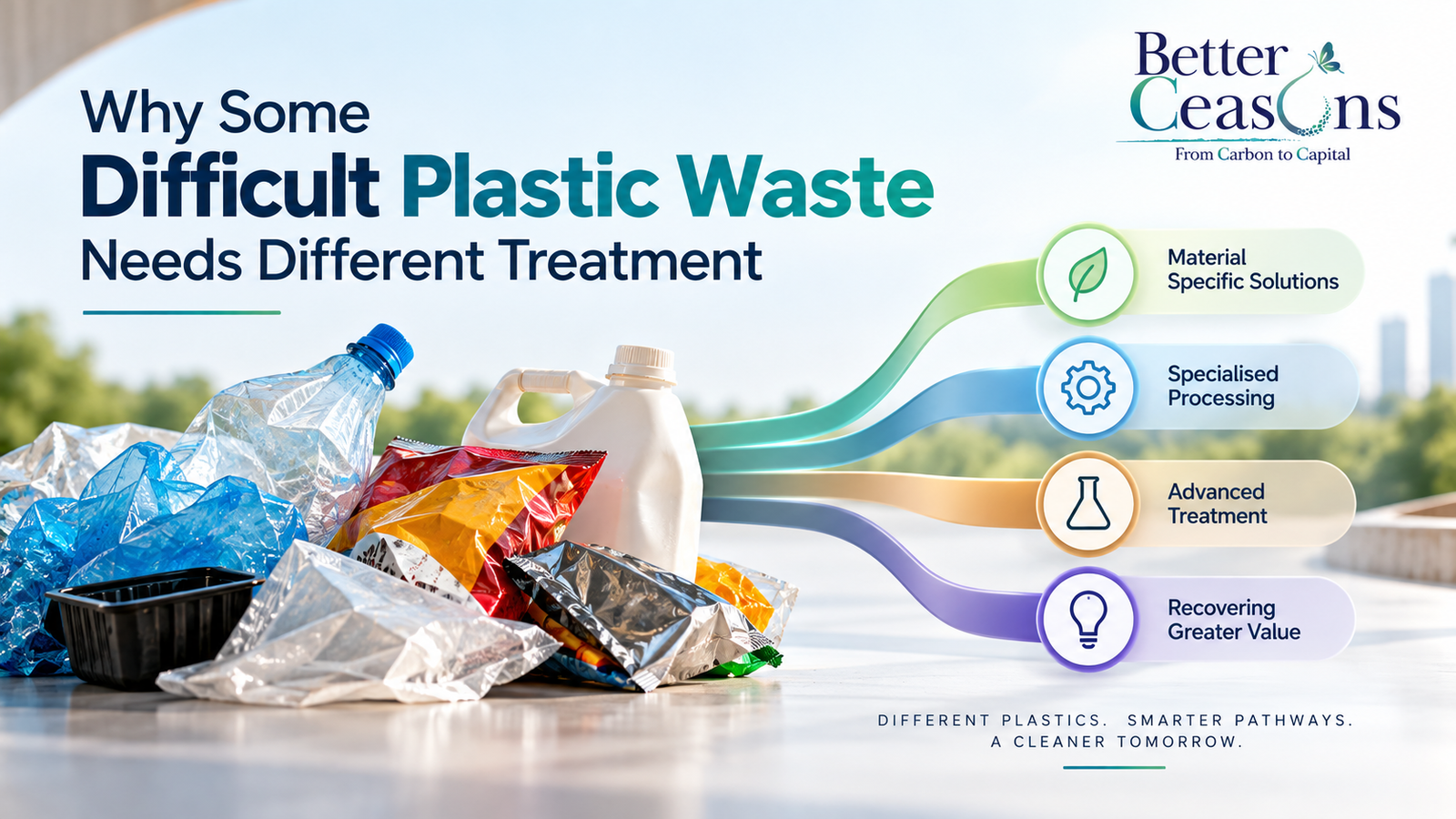
Difficult plastic waste includes mixed polymers, multilayer packaging, heavily contaminated plastic and degraded materials that standard recycling systems may struggle to handle. Different plastics have different chemical and physical properties, so responsible plastic management requires choosing treatment based on material composition rather than assuming one process works for everything.
Plastic Is a Family of Materials
People often use the word plastic as though it describes one uniform substance. In reality, plastic includes many different polymers and product structures. A transparent beverage bottle, flexible film, detergent container and snack pouch may all be called plastic, but they can behave very differently during processing. This becomes particularly important after the material has been used. Some plastics fit established recycling systems relatively well. Others become difficult plastic waste.What Makes Plastic Difficult?
Plastic can become difficult to process for several reasons. These include:- mixed polymer types
- multilayer construction
- food contamination
- oil or chemical contamination
- adhesives
- labels
- coatings
- fillers
- pigments
- degraded material quality
Mixed Plastic Materials Behave Differently
Imagine a stream containing several different polymers. Each polymer may soften, melt or degrade at different conditions. Processing them together can therefore produce inconsistent material properties. A recycled plastic product generally needs predictable characteristics. If the input changes constantly, achieving consistent performance becomes more difficult. This is one of the central plastic processing challenges associated with mixed waste.Why Multilayer Plastic Is Challenging
Modern packaging often uses multiple layers because each layer serves a specific function. One may provide strength. Another may block oxygen. Another may resist moisture. Another may make printing easier. This design can protect products extremely well. However, those same layers can become difficult to separate after use. A piece of multilayer plastic may contain several materials permanently bonded together. Conventional mechanical recycling systems may struggle to separate them economically.Contamination Changes the Equation
Contaminated plastic may still be technically recoverable, but cleaning has an impact. Washing requires water. Drying requires energy. Additional sorting requires equipment. If contamination is severe, the environmental and economic cost of restoring the material may become significant. That does not mean contaminated plastic has no value. It means the appropriate next pathway may be different.Better Segregation Helps, but Only to a Point
Keeping plastics separate from food and unrelated materials can help improve recovery. However, segregation cannot reverse every material-design problem. A multilayer pouch remains multilayer even when placed perfectly into the correct bin. This is why Better Ceasons questions the idea that sorting alone solves waste through Segregation The Urban Myth. Segregation can organise the problem. Treatment still has to solve what happens next.Mechanical Recycling Remains Important
For suitable clean and reasonably consistent plastic streams, mechanical recycling remains an important pathway. The purpose of discussing difficult plastics is not to dismiss recycling. It is to recognise its limits. Forcing every plastic into the same process can reduce output quality and increase rejection. A more mature system uses different pathways for different materials.What Other Treatment Options Exist?
Depending on the material, alternatives may include specialised recycling processes, chemical treatment, controlled thermal transformation or other forms of resource recovery. Better Ceasons explores controlled thermal transformation through Pyrolysis and Net Zero. This does not mean pyrolysis should automatically receive every difficult plastic stream. Suitability must be assessed. Feedstock composition, contamination, process controls and final output use all matter.Difficult Does Not Mean Worthless
One of the most important changes in waste thinking is separating the idea of “difficult” from “useless.” A material may be difficult to recycle mechanically while still containing recoverable chemical, carbon or energy value. Better Ceasons explores this broader mindset through The Magic. The question becomes: What useful value remains, and what responsible technology can recover it?Product Design Also Matters
Some plastic waste challenges begin long before disposal. Designers and manufacturers influence what happens at end of life through choices such as:- polymer combinations
- adhesives
- pigments
- labels
- barrier layers
- packaging formats
Avoid One-Solution Thinking
Plastic waste is too diverse for one slogan. “Recycle everything” oversimplifies the material challenge. “Convert everything” does the same. A better approach is: Understand the material. Check whether it can be reused. Assess mechanical recycling. Consider specialised recovery when necessary. Manage remaining residues responsibly. This material-specific hierarchy creates more realistic decisions.Final Thought
Difficult plastic waste needs different treatment because plastic itself is not one material. Mixed polymers, contamination and multilayer structures can change what recovery methods are practical. The objective should not be to force every plastic through the same system. It should be to understand what the material is and find its most responsible next pathway.How to Evaluate Treatment Options for Difficult Plastic Waste
A practical framework for assessing mixed, multilayer, contaminated and degraded plastic waste and identifying an appropriate recovery or treatment pathway.
Identify the plastic material
Determine the type of plastic, polymer composition and product structure before considering a recovery or treatment pathway.
Check for mixed polymers
Assess whether multiple polymer types are present because different materials can behave differently during processing.
Evaluate multilayer construction
Identify bonded layers, coatings, adhesives and barrier materials that may make conventional separation or mechanical recycling more difficult.
Assess contamination
Review food residue, oils, chemicals, moisture and other contamination that could increase cleaning, sorting and processing requirements.
Consider reuse or mechanical recycling
Check whether the material can be reused or processed through an established mechanical recycling pathway before considering alternative treatment.
Evaluate specialised recovery options
For materials that are unsuitable for conventional recycling, assess appropriate specialised recycling, chemical treatment or controlled recovery pathways.
Consider output quality and end use
Evaluate whether the selected treatment can produce a consistent and responsibly usable output.
Choose a material-specific pathway
Select the most appropriate realistic pathway based on material composition, contamination, available infrastructure and responsible end use.
Key Questions Answered
What is difficult plastic waste?↓
It generally refers to mixed, contaminated, multilayer or degraded plastics that standard recycling systems struggle to process consistently.
Why is multilayer plastic hard to recycle?↓
Different layers may be permanently bonded and made from materials with different processing requirements.
Can contaminated plastic still be recovered?↓
Sometimes. The feasibility depends on the type and level of contamination and the available treatment infrastructure.
Is all mixed plastic unsuitable for recycling?↓
No. Some mixed streams can be sorted or processed, but highly variable mixtures can create quality challenges.
Can pyrolysis process difficult plastic?↓
Certain suitable plastic feedstocks may be considered for pyrolysis, but material composition and process requirements must first be evaluated.
Written by Team Better Ceasons
Better Ceasons Editorial Team
Better Ceasons is a clean-technology enterprise transforming municipal solid waste streams into high-value carbon resources and renewable energy.
Explore Clean Tech Solutions
Better Ceasons has developed a solution that converts suitable plastic waste into fuel, supporting responsible resource recovery.
Contact Better Ceasons