
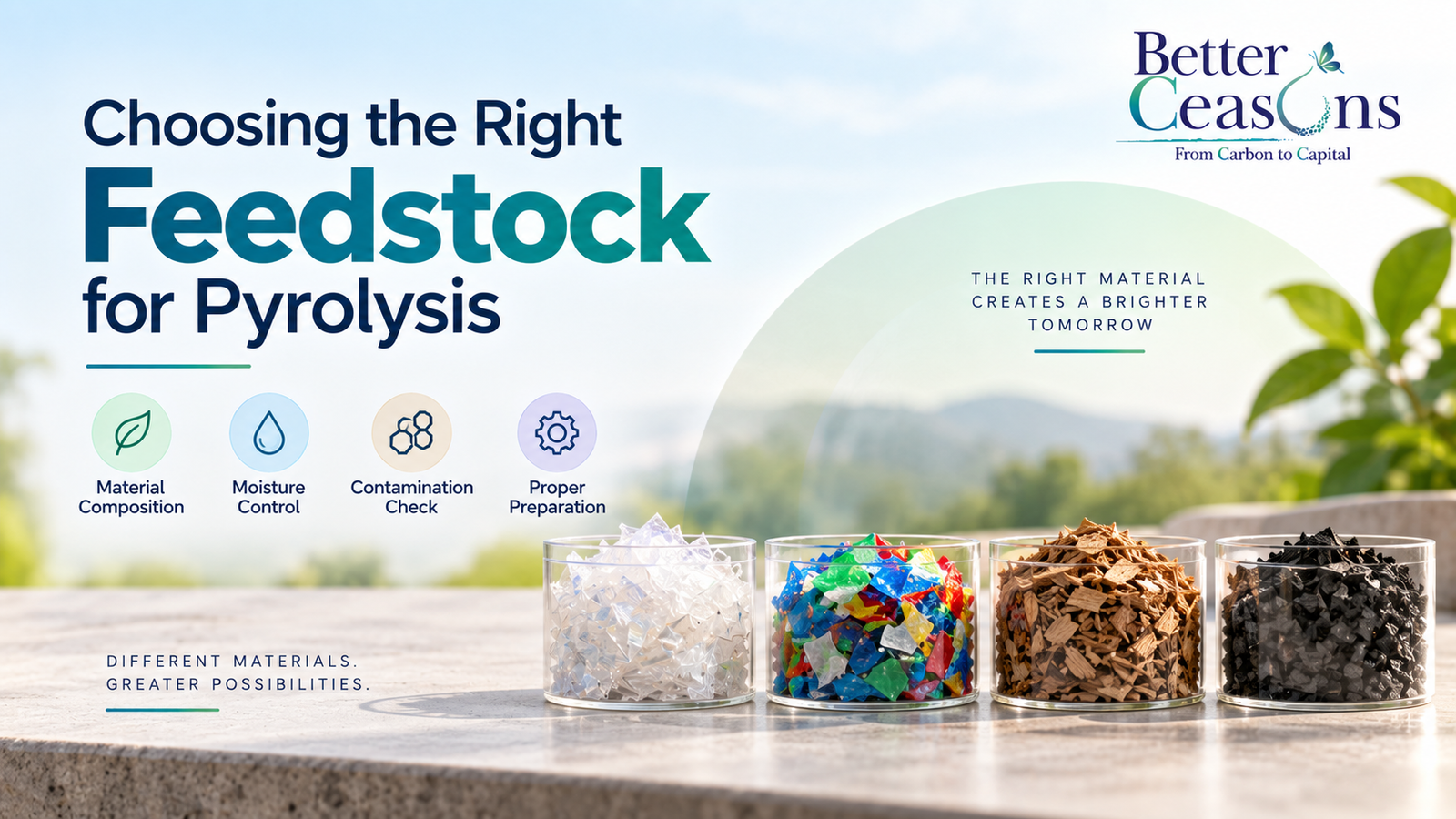
Choosing the right feedstock for pyrolysis means assessing material composition, moisture, contamination, particle size and compatibility with the reactor. Different materials respond differently to heat, so suitable feedstock selection is essential for stable processing and predictable outputs.
The Process Begins Before the Reactor
When people talk about pyrolysis, attention usually goes to the reactor. But the reactor can only work with the material it receives. If the input varies dramatically, operating conditions may also become less predictable. This makes feedstock selection one of the most important parts of the process.What Is Feedstock?
Feedstock is simply the material supplied to a conversion process. In pyrolysis, suitable carbon-containing materials are exposed to controlled heat where oxygen is absent or strongly limited. However, “waste” is not one feedstock. Different waste streams can contain very different compounds. This is why Better Ceasons treats material understanding as an important part of Pyrolysis and Net Zero.Composition Matters
Different pyrolysis input materials behave differently. A relatively consistent polyethylene stream may respond differently from a mixed load containing several polymers. Biomass behaves differently again. Even visually similar feedstocks may contain:- additives
- pigments
- moisture
- fillers
- coatings
- metals
- paper
- food residue
Feedstock Quality Means Control
Feedstock quality does not necessarily mean perfectly clean material. Waste-treatment systems often exist precisely because materials are imperfect. Quality, in this context, means knowing enough about the material to operate responsibly. A controlled input allows operators to make better decisions around temperature, residence time, feeding rate and output handling.Moisture Can Influence Efficiency
Water requires energy to heat. If feedstock contains significant moisture, some of the reactor's energy may be used simply to evaporate that water. This can affect process efficiency. For some materials, drying may therefore be part of material preparation. However, drying also consumes energy. The goal should be appropriate moisture management rather than unnecessary processing.Particle Size Matters
Very large pieces may not heat as evenly as smaller ones. Irregular material can also create feeding problems. Size reduction through shredding or cutting can sometimes create a more consistent feed. But smaller is not automatically better. Excessive shredding adds equipment use and energy demand. Preparation should be driven by process needs.Contaminants Need Attention
Foreign materials may create operational problems. Examples can include:- stones
- glass
- metal
- soil
- excessive chlorine-containing materials
- incompatible waste
Consistency Helps Reactor Control
A highly variable feedstock creates a moving target. One batch may contain more moisture. Another may contain different polymers. Another may contain more contamination. These variations can make reactor behaviour less predictable. Greater feedstock consistency can support more stable:- temperature control
- material flow
- residence time
- output characteristics
Not Every Waste Stream Belongs in Pyrolysis
One of the most important feedstock decisions is recognising when pyrolysis is not the appropriate pathway. Some materials may be better suited to:- reuse
- mechanical recycling
- biological treatment
- another specialised recovery route
Consider the Intended Output
Feedstock should also be evaluated in relation to what the process is intended to produce. Different materials and conditions may generate different proportions of solid, liquid and gaseous fractions. If an operator requires a particular output, choosing an unsuitable feedstock can create problems even when the reactor itself operates correctly.Feedstock Also Affects Environmental Performance
Feedstock preparation, transport and contamination management all use resources. For example, a material that requires extensive washing, drying and long-distance transport may have a different environmental profile from one available locally in suitable condition. That is why feedstock decisions matter when pyrolysis is discussed alongside climate goals.Start With the Material
Waste-treatment discussions often begin with: “What technology should we install?” A better sequence is: What material do we have? How much? How consistent is it? What contamination is present? What recovery pathways already exist? Only then should the technology decision follow.Conclusion
Choosing the right feedstock for pyrolysis is not simply about finding enough waste to keep a reactor running. It is about understanding the material well enough to create stable, controlled and responsible processing. The machine matters. But the material comes first.How to Evaluate Feedstock for Pyrolysis
A practical framework for evaluating feedstock composition, moisture, contamination, size, consistency and suitability before considering pyrolysis.
Identify the material composition
Determine the type of material and identify polymers, additives, coatings, fillers, pigments and other components that may influence processing.
Assess feedstock quality
Evaluate how controlled and consistent the incoming material is so operating conditions can be planned more predictably.
Check moisture levels
Review moisture content because excess water can increase energy requirements and influence process efficiency.
Evaluate material size
Assess whether the feedstock size and shape are suitable for consistent handling and heating without unnecessary preparation.
Identify contaminants
Check for foreign materials such as metal, glass, stones, soil, incompatible materials and other contaminants that may create operational or environmental concerns.
Review feedstock consistency
Determine how much the composition, moisture and contamination levels vary between batches because inconsistent feedstock can make process control more difficult.
Consider alternative recovery pathways
Check whether reuse, mechanical recycling, biological treatment or another specialised recovery pathway may be more appropriate before selecting pyrolysis.
Consider the intended output
Evaluate whether the feedstock characteristics are compatible with the intended solid, liquid or gaseous output objectives.
Assess the wider environmental impact
Consider transportation, washing, drying, preparation requirements and other resource use when evaluating overall feedstock suitability.
Key Questions Answered
What is feedstock for pyrolysis?↓
Feedstock is the material supplied to the pyrolysis process.
Why does feedstock quality matter?↓
More controlled and consistent feedstock can improve reactor stability and output predictability.
Does moisture affect pyrolysis?↓
Yes. Excess moisture can increase energy requirements because water needs to be heated and evaporated.
Can mixed plastic be used as pyrolysis feedstock?↓
Certain mixed plastic streams may be suitable, but composition and contaminants need to be evaluated.
Is every waste material suitable for pyrolysis?↓
No. Some materials have better pathways through recycling, reuse or other treatment systems.
Written by Team Better Ceasons
Better Ceasons Editorial Team
Better Ceasons is a clean-technology enterprise transforming municipal solid waste streams into high-value carbon resources and renewable energy.
Explore Clean Tech Solutions
Better Ceasons has developed a solution that converts suitable plastic waste into fuel, supporting responsible resource recovery.
Contact Better Ceasons