
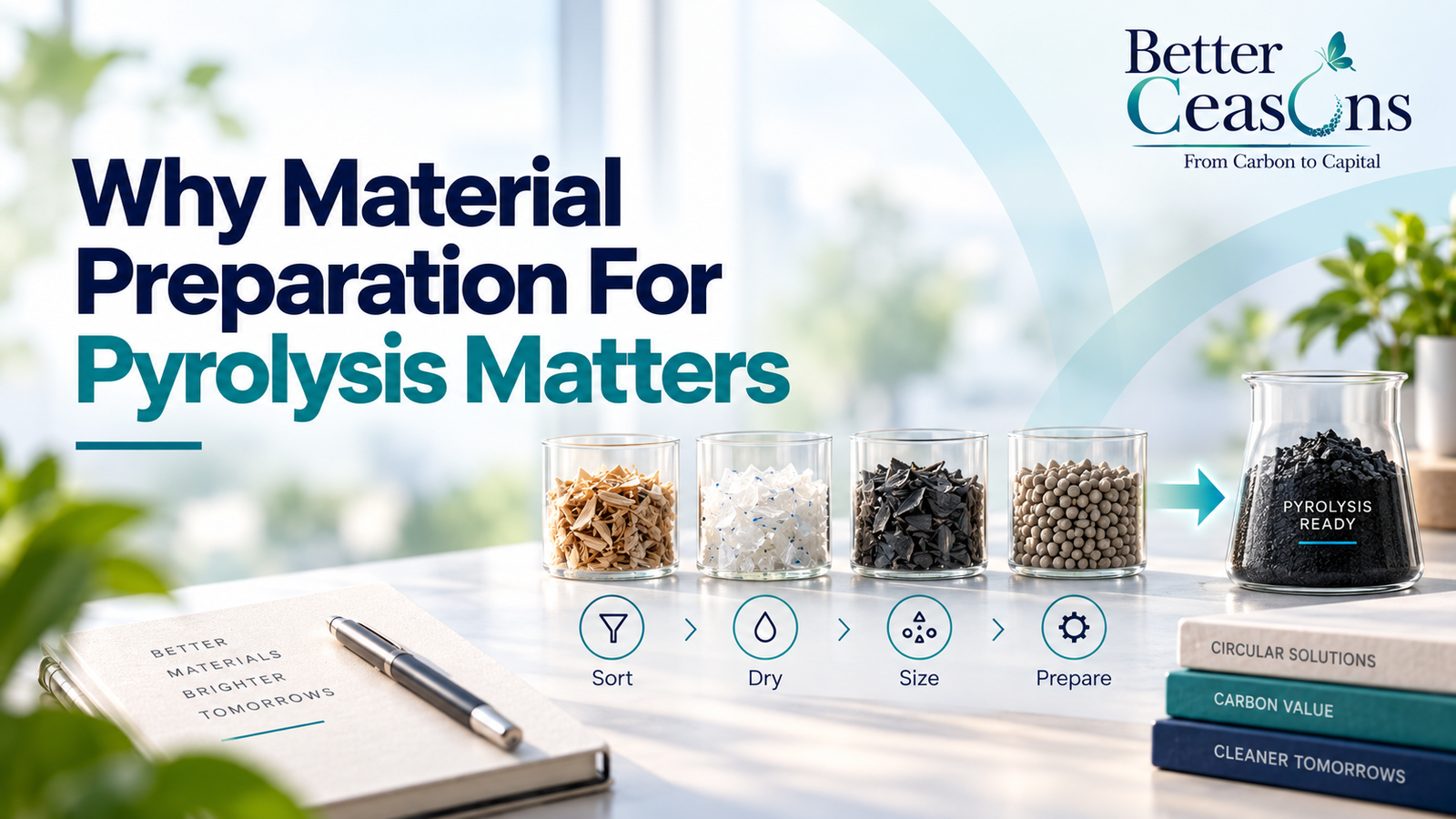
Material preparation for pyrolysis helps create more consistent reactor conditions by controlling feedstock composition, moisture, contamination and particle size before processing. Preparation does not make every waste stream suitable for pyrolysis, but it can improve material handling, process stability and output predictability for appropriate feedstocks.
Quick Answer
Material preparation for pyrolysis helps create more consistent reactor conditions by controlling feedstock composition, moisture, contamination and particle size before processing. Preparation does not make every waste stream suitable for pyrolysis, but it can improve material handling, process stability and output predictability for appropriate feedstocks.
The Reactor Is Not the First Step
The most visible part of a pyrolysis system is often the reactor.
However, the process begins much earlier.
Waste rarely arrives in a perfectly consistent condition.
One load may be wet.
Another may contain metals.
Another may contain large pieces.
Another may contain several different polymers.
These differences can affect how the material behaves during heating.
This is why material preparation for pyrolysis should be treated as part of the process itself.
Start With Material Identification
Before physical preparation begins, operators need to understand the feedstock.
Important questions include:
What is the material?
Is it a single material or a mixture?
How much moisture does it contain?
Are there metals or other contaminants?
Does it contain components that are unsuitable for the intended reactor?
Identification supports better decisions later.
Feedstock Preparation Improves Control
Feedstock preparation can involve different steps depending on the material.
These may include:
sorting
contaminant removal
drying
cutting
shredding
blending
controlled storage
Not every feedstock requires every step.
Preparation should be designed around what is necessary for the specific process.
Moisture Control Matters
Water changes the thermal behaviour of a feedstock.
Energy is required to raise the temperature of water and eventually evaporate it.
If the feedstock is excessively wet, part of the process energy is spent managing moisture instead of driving the intended reactions.
Appropriate moisture control can therefore support thermal efficiency.
However, drying also consumes energy.
The objective is not to make every feedstock perfectly dry regardless of cost.
The goal is to maintain a suitable range.
Size Reduction Can Improve Feeding
Very large or irregular material can create mechanical challenges.
Feed systems may struggle to move oversized pieces into the reactor consistently.
Different particle sizes can also heat at different rates.
Size reduction through shredding or cutting can create a more manageable feed.
Again, balance matters.
Grinding material unnecessarily small increases equipment use and energy consumption.
Preparation should solve a real process need.
Remove Materials That Do Not Belong
A waste stream can contain objects that are not appropriate for the reactor.
Examples may include:
glass
stones
metals
excessive soil
incompatible materials
These can affect feeding equipment, residues and maintenance.
Material checks before processing reduce avoidable operational problems.
Consistency Supports Process Efficiency
No real-world waste feedstock will ever be perfectly identical.
However, reducing extreme variation helps operators maintain more stable conditions.
This can support:
predictable material flow
consistent heating
better residence-time control
stable output characteristics
improved process efficiency
A process becomes easier to manage when operators have a reasonable understanding of what enters it.
Preparation Does Not Replace Feedstock Suitability
This distinction is important.
Shredding, drying and sorting an unsuitable material does not automatically make it suitable for pyrolysis.
The material still needs to be compatible with the process.
Better Ceasons discusses material-specific treatment through Pyrolysis and Net Zero.
Not all waste should follow the same pathway.
Preparation Has Its Own Environmental Cost
Every preparation stage consumes resources.
Shredders use electricity.
Dryers need energy.
Washing may use water.
Transporting material between preparation facilities adds emissions.
This means preparation should be efficient rather than excessive.
A process that requires very intensive preparation should consider whether the environmental and economic benefits still make sense.
Storage Is Part of Preparation
Feedstock can change condition while waiting for treatment.
Material left uncovered may absorb rainwater.
Mixed material may become more contaminated.
Loose lightweight plastic can become difficult to contain.
Appropriate storage protects the effort already invested in sorting and preparation.
Better Preparation Supports Better Data
Consistent feedstock also makes process data more useful.
If inputs change dramatically every hour, it becomes difficult to understand why reactor outputs change.
Better-controlled material allows operators to connect operating conditions with actual results.
This supports optimisation.
Material Comes Before Transformation
Better Ceasons’ broader The Magic perspective looks at waste as material that may still contain useful value.
But recovering that value responsibly begins with understanding the material.
Preparation is where that understanding becomes operational.
Final Thought
Material preparation for pyrolysis is not simply a housekeeping task before the “real†process begins.
It influences feed stability, energy use, reactor control and output consistency.
The reactor performs the transformation.
But responsible transformation begins before the material ever enters it.
How to Prepare Material for Pyrolysis
A practical process for preparing suitable feedstock before pyrolysis by identifying the material, controlling moisture, reducing particle size, removing contaminants and maintaining suitable storage.
Identify the feedstock
Determine what the material is, whether it is a single material or mixture, its moisture level, possible contaminants and whether it is compatible with the intended pyrolysis system.
Sort the material
Separate incompatible materials and organise the feedstock into suitable streams based on composition and process requirements.
Remove contaminants
Remove materials such as metals, glass, stones, excessive soil and other contaminants that may interfere with feeding, residues, equipment or maintenance.
Control moisture
Assess and manage feedstock moisture so that excessive water does not consume unnecessary thermal energy during processing.
Reduce particle size where necessary
Use cutting or shredding when required to make large or irregular material easier to handle and feed consistently into the reactor.
Blend material where appropriate
Where compatible with the process, blend suitable feedstock to reduce extreme variation and support more consistent operating conditions.
Store prepared feedstock correctly
Protect prepared material from rain, additional contamination and uncontrolled mixing before it enters the pyrolysis process.
Monitor feedstock consistency
Track changes in moisture, composition, particle size and contamination so process data can be compared more reliably with reactor performance.
Key Questions Answered
Why is material preparation important for pyrolysis?↓
It helps control moisture, size, contamination and composition before material reaches the reactor.
Does pyrolysis feedstock need to be dry?↓
Moisture requirements vary by system, but excessive moisture can increase energy demand.
Why is plastic shredded before pyrolysis?↓
Size reduction can improve feeding and help create more consistent heating conditions.
Can preparation make every material suitable?↓
No. Fundamental feedstock suitability still needs to be assessed.
Does feedstock preparation use energy?↓
Yes. Drying, shredding, washing, and other preparation steps can consume energy and should therefore be used appropriately.
Written by Team Better Ceasons
Better Ceasons Editorial Team
Better Ceasons is a clean-technology enterprise transforming municipal solid waste streams into high-value carbon resources and renewable energy.
Explore Clean Tech Solutions
Better Ceasons has developed a solution that converts suitable plastic waste into fuel, supporting responsible resource recovery.
Contact Better Ceasons