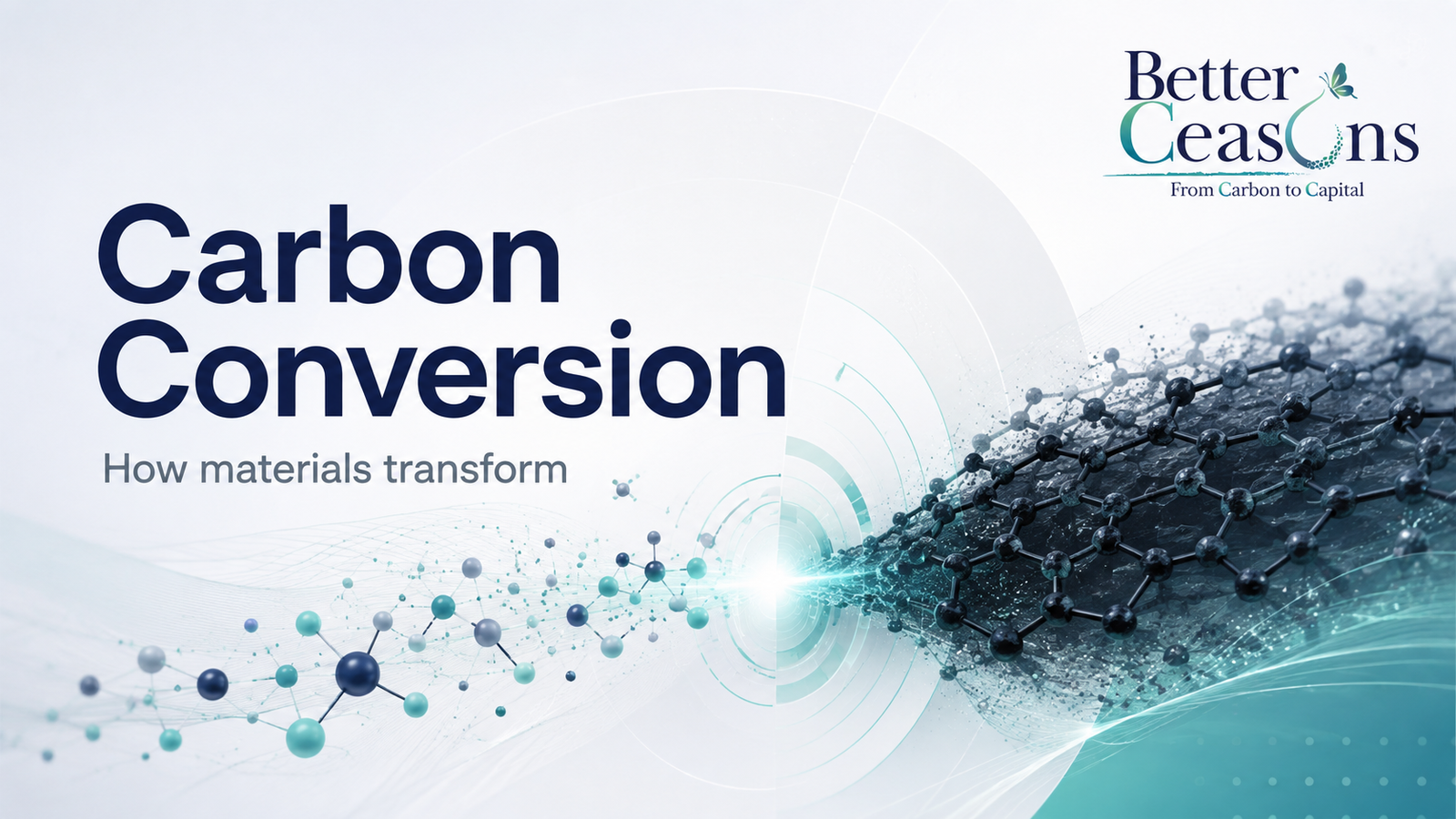
Waste does not simply disappear after we discard it. Many waste materials still contain carbon, energy and chemical compounds that can potentially be...
Waste does not simply disappear after we discard it. Many waste materials still contain carbon, energy and chemical compounds that can potentially be recovered through the right treatment process.
So, how is waste converted to carbon?
In simple terms, suitable carbon containing waste can be heated or treated under controlled conditions that remove part of its moisture, oxygen, hydrogen and volatile compounds while leaving behind a more carbon rich material. Depending on the feedstock and technology, the resulting material may be called char, biochar, hydrochar or another carbon rich solid. But this does not mean every type of waste can be turned into pure carbon. Understanding waste to carbon conversion begins with understanding what the waste contains and how different conversion processes change it.Quick Answer
Waste can be converted into carbon rich material through processes such as waste carbonization, pyrolysis and hydrothermal carbonization. These technologies alter carbon containing materials under controlled heat and environmental conditions. Pyrolysis generally heats suitable material with little or no oxygen, producing solid char alongside gases and liquids. Hydrothermal carbonization can process wet organic materials in hot compressed water, producing carbon rich hydrochar. The final output depends heavily on the original waste and operating conditions.Waste Already Contains Carbon
The phrase waste converted to carbon can make it sound as though carbon is created during treatment. That is not usually what happens. Carbon is already present in many materials. Food residues contain carbon because they were once part of living organisms. Wood, agricultural residues, paper and other biomass contain carbon stored through biological processes. Plastics also contain large amounts of carbon because most conventional plastics are made from hydrocarbon based raw materials. When these materials become waste, their carbon does not disappear. It remains within the material until biological, chemical or thermal processes change its form. This is why Better Ceasons looks beyond the idea of waste as something that has simply reached the end of its usefulness. The Waste Illusion explores this wider idea that discarded material continues to exist and move through environmental and material systems. Understanding the carbon already present in discarded material is the first step towards understanding carbon recovery from waste.What Does Waste Carbonization Actually Mean?
Waste carbonization is the controlled transformation of suitable carbon containing material into a more carbon rich solid. During carbonization, heat changes the chemical structure of the material. Moisture is removed. Some volatile compounds leave the material. Hydrogen, oxygen and other elements may be released within gases, vapours or liquids. A greater proportion of the remaining solid can therefore consist of carbon. IUPAC describes carbonization as a process in which organic substances are converted into a carbonaceous residue through pyrolysis, with temperature influencing the degree of carbonization. The important point is that waste carbonization is a transformation process rather than a simple separation process. A sorting machine might separate one material from another. Carbonization actually changes the material itself.How Pyrolysis Converts Waste Into Carbon Rich Products
One of the most widely discussed technologies in waste to carbon conversion is pyrolysis. Pyrolysis involves heating an organic or carbon containing material in the absence, or near absence, of oxygen. That oxygen restriction is important. If sufficient oxygen were present at high temperatures, the material could burn through combustion. During pyrolysis, the aim is instead to thermally break larger molecules into different products. According to the United States Department of Agriculture, biomass pyrolysis can produce three broad output streams consisting of a solid char, liquid bio oil and gases. Their proportions vary according to the feedstock and operating conditions. For pyrolysis of waste, the process can be understood in several stages.The Material Is Prepared
Suitable waste is first identified and prepared. Depending on the process, preparation may involve removing incompatible materials, reducing particle size, controlling moisture or creating a more consistent feedstock. This stage matters because pyrolysis of waste does not perform identically with every material. Wood behaves differently from agricultural residue. Food derived biomass behaves differently from plastic. Mixed and contaminated waste creates additional technical challenges.Heat Breaks Down the Material
The prepared material enters a controlled reactor and is exposed to elevated temperatures. Instead of simply melting the material, sufficient heat begins breaking chemical bonds. Larger organic molecules become smaller molecules. Some leave the reactor as vapours or gases, while part of the original carbon remains concentrated in the solid fraction.Different Carbon Containing Products Form
The exact balance between solid, liquid and gaseous products depends on temperature, heating rate, residence time, feedstock composition and reactor design. This is why waste converted to carbon should not be understood as a single fixed formula. Changing the process conditions can change the result. Better Ceasons examines the role of this controlled thermal process through Pyrolysis and Net Zero, particularly in the wider discussion about carbon, conversion and the future of difficult material streams.What Is the Solid Carbon Rich Material?
The solid material left after thermal conversion is commonly described as char or a carbonaceous solid. When biomass is converted under suitable conditions and the material meets its intended definitions and applications, the term biochar may be used. This is where waste to biochar becomes relevant. Agricultural residues, wood residues and selected organic materials can potentially undergo controlled thermochemical processing that leaves a carbon rich solid. Research has shown that biomass can be converted into biocarbon materials through pyrolysis, with processing temperature affecting carbon content, surface characteristics and other properties. However, not every char should automatically be described as biochar. A carbonaceous solid produced from plastic, for example, is not the same thing as waste to biochar conversion from suitable biological feedstocks. The original material matters. The production process matters. The properties of the final solid matter. And its intended use matters.Wet Waste Can Follow a Different Carbon Pathway
Traditional pyrolysis generally benefits from controlling moisture because a large amount of water requires additional energy to heat and evaporate. Wet organic material can therefore create another challenge. One possible alternative is hydrothermal carbonization. Instead of requiring a dry feedstock, hydrothermal carbonization treats suitable organic materials using hot compressed water. Under these conditions, the material undergoes chemical reactions that create a carbon rich solid known as hydrochar. Research highlighted by the Government of India has demonstrated hydrothermal treatment of wet municipal organic waste to produce hydrochar while taking advantage of moisture already present in the feedstock. This makes hydrothermal carbonization particularly interesting when drying wet organic material would otherwise consume significant energy. It is another reminder that waste to carbon conversion should be matched to the characteristics of the material rather than forcing every waste stream through one process.Biochar and Hydrochar Are Not the Same
The terms are sometimes used as though they describe identical materials, but their production pathways are different. Waste to biochar generally involves thermal processing of biomass under oxygen limited conditions, commonly through pyrolysis. Hydrochar is produced through hydrothermal carbonization, where suitable material reacts in heated pressurised water. Both can be carbon rich, but their chemical structures, moisture behaviour, surface characteristics and possible applications may differ. USDA research describes hydrothermal carbonization as a pathway capable of processing wet biomass residues into char based products while conventional dry pyrolysis provides a different conversion route. Choosing between them therefore requires more than asking which technology produces carbon. The better question is which technology fits the feedstock.Can Plastic Waste Be Converted Into Carbon?
Plastic contains carbon, so controlled thermal treatment can transform its carbon containing molecular structure. However, pyrolysis of waste plastic frequently aims to recover hydrocarbons in liquid and gaseous fractions rather than maximise a solid carbon product. A solid carbonaceous residue may also remain, depending on the polymer type, contamination and processing conditions. This makes plastic fundamentally different from waste to biochar pathways involving biomass. Plastic derived solids should not automatically be described using biological carbon terminology. This distinction matters because carbon recovery from waste can mean different things. For one material, carbon recovery might mean producing a carbon rich solid. For another, it might mean recovering useful hydrocarbons. For another, biological treatment could be more appropriate. Waste chemistry should determine the pathway.What Types of Waste Can Be Carbonized?
Not every item placed in a waste stream is a useful candidate for waste carbonization. Materials with significant carbon containing organic fractions are the most relevant starting point. Potential feedstocks may include selected agricultural residues, forestry residues, food processing residues, plant based biomass, sewage derived material and some other carbon containing waste streams. The US Environmental Protection Agency notes that biomass and several other carbonaceous waste streams can be converted into stable carbon rich materials using processes including pyrolysis and hydrothermal carbonization. Suitability still depends on factors such as contamination, moisture, composition, mineral content, process temperature and the desired output. A responsible system therefore begins with material identification. It does not begin by assuming every waste stream belongs in the same reactor.Why Segregation Still Matters Before Conversion
Imagine a waste stream containing food residues, glass, metal, plastic packaging, paper and other materials. Calling all of it simply “waste” hides important differences. Glass does not react like biomass. Metal does not behave like food residue. Plastic does not behave like agricultural material. This is why segregation and material understanding remain important for carbon recovery from waste. But segregation alone is not the complete solution. The separated material still needs an appropriate destination and treatment pathway. Better Ceasons explores this challenge in Segregation The Urban Myth, highlighting why sorting materials is only useful when suitable systems exist after segregation. The destination matters as much as the bin.Where Does the Carbon Go During Conversion?
A useful way to understand how waste is converted to carbon is to follow the carbon atoms. Before treatment, carbon is distributed throughout the waste material's molecules. During thermal conversion, those molecules break apart. Some carbon can remain in the solid char. Some can move into liquid products. Some can become part of gases such as carbon monoxide, carbon dioxide or hydrocarbon gases. The balance changes with the feedstock and operating conditions. That is why measuring only the quantity of solid carbon does not provide a complete environmental picture. The entire carbon flow needs to be understood. Better Ceasons' Carbon perspective explores this broader movement of carbon and why its form, pathway and destination matter when thinking about environmental systems.Carbon Conversion Is Not Automatically Carbon Removal
This distinction is especially important. Producing a carbon rich material does not automatically mean carbon has permanently been removed from the atmosphere. The climate outcome depends on where the original carbon came from, how much energy the conversion process consumes, what emissions occur, what happens to liquid and gaseous products, how stable the resulting carbon is and what happens to that carbon later. For example, a carbon rich solid that is quickly burned will have a different carbon pathway from a stable material kept out of rapid decomposition for a long period. This is why responsible carbon recovery from waste requires lifecycle thinking. The technology itself is only one part of the environmental equation.Why Waste to Carbon Conversion Matters
Modern waste systems face a difficult problem. Some materials can be avoided. Some can be reused. Some can be mechanically recycled. Some organic materials can follow biological treatment pathways. But other carbon containing waste streams may remain difficult to manage through conventional routes. For suitable materials, waste to carbon conversion can create another possible pathway. Controlled processing may reduce the volume of the original material while producing solid, liquid or gaseous outputs with potential value. Projects supported by India's Department of Science and Technology have investigated systems combining organic waste treatment and pyrolysis to produce biochar and useful energy products. The opportunity is therefore larger than simply changing one form of waste into another. It is about understanding whether useful carbon can remain within managed material cycles rather than being treated only as something to discard.From Waste to a Carbon Resource
So, how is waste converted to carbon?
Suitable carbon containing waste undergoes controlled physical, chemical and thermal changes that concentrate or redistribute the carbon already present within it. Through waste carbonization, part of the material can become a carbon rich solid. Through pyrolysis of waste, carbon can be distributed between char, liquids and gases. Through hydrothermal carbonization, wet organic material can become hydrochar. Through waste to biochar pathways, suitable biomass can be transformed into carbon rich material with characteristics determined by both its source and treatment conditions. None of these processes makes every waste stream identical. And none should be treated as a universal solution. The more useful approach is to stop asking only how quickly waste can be removed and begin asking what the material contains, where its carbon is going and whether that carbon can be managed more intelligently. That shift is central to the Better Ceasons approach to seeing discarded materials differently. Waste may be the name we give something after use. Carbon reminds us that the material itself is still there.How Waste Is Converted Into Carbon Rich Material
A step by step overview of how suitable carbon containing waste can be prepared and processed through controlled thermal conversion to produce carbon rich solid material and other outputs.
Identify a suitable carbon containing waste stream
Determine whether the waste contains suitable carbon based material such as selected biomass, agricultural residues, forestry residues, food processing residues or other appropriate carbon containing feedstocks.
Segregate incompatible materials
Separate materials such as glass, metals and other incompatible components because different waste streams behave differently during carbon conversion.
Prepare the feedstock
Prepare the selected material by reducing incompatible contamination, controlling particle size and managing moisture where required by the chosen process.
Select the appropriate conversion process
Choose a process according to the characteristics of the feedstock. Pyrolysis may be suitable for selected carbon containing materials, while hydrothermal carbonization can be considered for suitable wet organic feedstocks.
Apply controlled thermal conditions
Expose the prepared feedstock to controlled heat and environmental conditions. During pyrolysis, the material is heated with little or no oxygen so that thermal decomposition occurs instead of ordinary combustion.
Break down the material structure
Heat breaks chemical bonds within the material. Moisture and volatile components are removed or redistributed while larger molecules break into smaller compounds.
Separate the conversion products
Depending on the process and operating conditions, carbon can be distributed between a solid char, liquid products and gaseous products.
Evaluate the carbon rich solid
Assess the properties of the resulting carbonaceous solid. Suitable biomass processed under appropriate conditions may produce material described as biochar, while hydrothermal carbonization produces hydrochar.
Assess the complete carbon pathway
Consider where carbon moves across the solid, liquid and gaseous outputs as well as process energy use, emissions and the eventual use or treatment of each product.
Key Questions Answered
How is waste converted to carbon?↓
Waste containing suitable carbon based material can be converted into carbon rich solids through processes such as pyrolysis and hydrothermal carbonization. Heat and controlled reaction conditions remove or redistribute volatile components while concentrating part of the original carbon within the remaining solid.
What is waste carbonization?↓
Waste carbonization is the conversion of suitable organic or carbon containing waste into a carbon rich material through controlled thermal or thermochemical processing.
Can all waste be converted into carbon?↓
No. Different waste streams contain different materials and require different treatment methods. Glass and metals, for example, do not follow the same carbon conversion pathways as biomass or carbon rich organic material.
What is the difference between pyrolysis and carbonization?↓
Carbonization describes the transformation towards a carbon rich residue. Pyrolysis is a thermal decomposition process that occurs with little or no oxygen and can produce solid char, liquids and gases. Carbonization can occur through pyrolysis under appropriate operating conditions.
Can organic waste be converted into biochar?↓
Suitable biomass and organic residues can undergo controlled pyrolysis to produce carbon rich material. Whether the resulting product is appropriately classified and used as biochar depends on the feedstock, processing conditions and final material properties.
What is hydrothermal carbonization?↓
Hydrothermal carbonization is a thermochemical process that treats wet organic material using heated compressed water and produces a carbon rich solid generally called hydrochar. It can be particularly relevant for feedstocks with high moisture content.
Written by Team Better Ceasons
Better Ceasons Editorial Team
Better Ceasons is a clean-technology enterprise transforming municipal solid waste streams into high-value carbon resources and renewable energy.
Explore Clean Tech Solutions
Better Ceasons has developed a solution that converts suitable plastic waste into fuel, supporting responsible resource recovery.
Explore Partnerships