
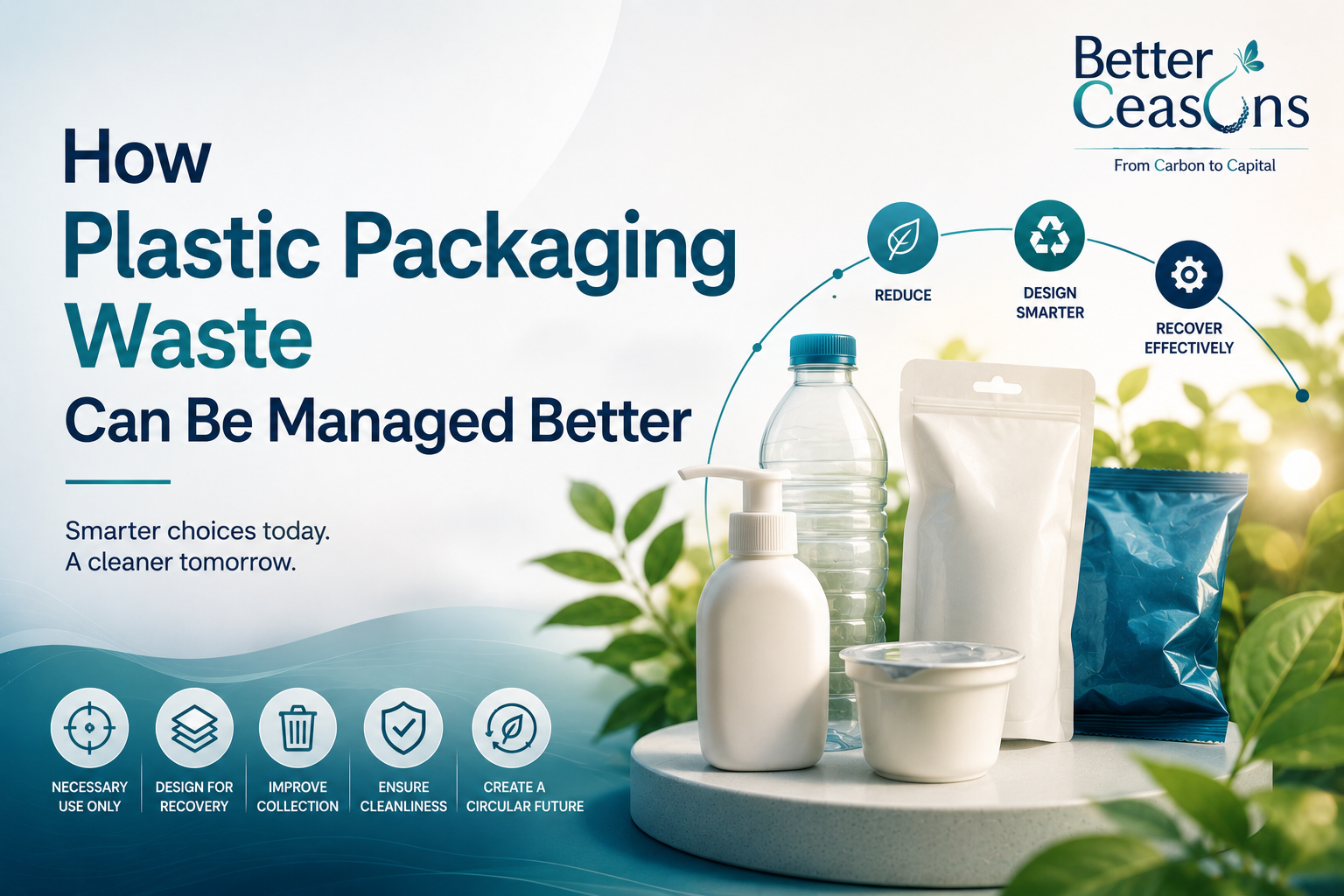
Plastic packaging is usually designed around one central...
Plastic packaging is usually designed around one central question.
How well will it protect the product?
That question has led to remarkable packaging.
Food can remain fresh longer.
Medicines can remain protected.
Liquids can travel safely.
Products can reach customers with less damage.
The difficulty begins after the package has finished doing all of that.
The material enters a waste system that may know much less about it than the packaging engineer who designed it.
A simple-looking pouch can contain several bonded layers.
A bottle can include labels, adhesives, pigments and closures made from different materials.
A takeaway container can reach the bin with food residue still attached.
Managing plastic packaging waste better therefore requires more than collecting more plastic.
It requires designing and operating a better material journey.
Begin by asking whether the packaging is necessary
Waste prevention starts before production.
Some packaging serves an essential protective function.
Some exists mainly for convenience, presentation or duplication.
Removing unnecessary material can eliminate waste without requiring another downstream technology.
The emphasis should remain on unnecessary.
Poorly considered packaging reduction can cause product damage, food loss or contamination, creating a different environmental problem.
The goal is not minimum packaging at any cost.
It is enough packaging to perform the required function without creating avoidable material use.
Design packaging with its afterlife in mind
A package should not become an engineering mystery the moment it enters a waste bin.
Material selection can influence whether recovery remains practical.
Simpler material structures can sometimes improve recyclability.
Labels and adhesives can be designed with downstream processing in mind.
Components can be made easier to separate.
Clearer material identification can help sorting.
This is where product design becomes part of waste management.
The end of the packaging journey should influence decisions made at the beginning.
Multilayer packaging creates a particular challenge
Multilayer plastic waste is often created for good functional reasons.
Different materials can provide different properties.
A layer may provide stiffness.
Another can form an oxygen barrier.
Another improves heat sealing.
Another protects against moisture.
The final package performs better because the layers work together.
Unfortunately, those same layers can be difficult to separate after use.
Better Ceasons' current discussion of mixed and difficult waste highlights composite materials as one reason familiar mechanical recycling routes may not work for every stream.
Collection quality matters
A recyclable package can lose its recovery potential when poorly collected.
Clean material mixed with wet food waste can become heavily contaminated.
Separated packaging mixed back into general waste during transportation can lose the benefit of segregation.
Light films can escape from open storage.
This means collection infrastructure influences recycling performance long before the material reaches a processor.
waste segregation at source remains useful because it helps identify and protect material, even though segregation by itself cannot complete the waste journey.
Consumers need instructions that reflect reality
Packaging disposal labels often simplify a complicated system.
A recycling symbol may suggest that a package is recyclable in principle.
That does not guarantee a local collection system accepts it.
Likewise, asking consumers to separate components that are practically impossible to separate does not create useful behaviour.
Better packaging instructions should reflect the actual infrastructure available to the person disposing of the product.
Clear communication reduces contamination and helps preserve trust.
Conventional recycling should be used where it works
There is no reason to abandon familiar recycling for material that can move effectively through it.
Clean, compatible plastic with established collection and processing routes should remain part of those systems.
The problem arises when the phrase recyclable is stretched to cover material that cannot realistically reach or survive the required process.
A credible system distinguishes theoretical recyclability from actual recoverability.
That distinction matters for brands as well as waste operators.
Difficult packaging needs a next step
What happens after conventional recycling says no?
This question sits at the centre of many packaging challenges.
Mixed laminates.
Contaminated films.
Composite structures.
Low-value flexible packaging.
These streams can end up labelled non recyclable waste.
Better Ceasons currently argues that this label should not automatically mean the material has no possible future. Instead, the next question should be whether another responsible recovery or transformation pathway exists.
Chemical recycling should be discussed precisely
Chemical recycling of plastic waste is often used as a broad term for technologies that break or transform plastic beyond conventional physical reprocessing.
These technologies vary.
Their inputs differ.
Their outputs differ.
Their energy requirements differ.
Their level of commercial maturity differs.
It is therefore more useful to evaluate a specific technology and feedstock than to debate the label in general.
What plastic can the process accept?
What contaminants cause problems?
What output is created?
How much of that output enters another productive use?
What happens to residues?
These questions reveal more than terminology.
Pyrolysis may suit selected plastic streams
Plastic waste pyrolysis is one controlled thermochemical pathway that can be evaluated for suitable hydrocarbon-rich plastic.
The feedstock enters an oxygen-restricted thermal process and breaks into gaseous, liquid and solid fractions.
However, Better Ceasons explicitly states that pyrolysis reactors are not universal machines and that feedstock chemistry and process design need to match.
This is particularly important in packaging because the word plastic can hide many different polymers, additives and composite materials.
Storage should preserve the material until processing
Packaging often has low bulk density.
Large volumes can accumulate quickly.
Poor storage can expose it to water, soil and other waste.
Once contamination increases, treatment options may decrease.
Storage therefore needs to connect with processing.
If material is being collected for a specific recycling or conversion route, the storage system should protect the properties that route requires.
Otherwise, collection effort can be lost before the material reaches the plant.
Better data can connect brands and waste processors
Brands know what packaging they purchase.
Packaging manufacturers know the material specifications.
Waste processors know what material actually arrives.
These groups often operate with incomplete information about each other.
Better data exchange can help close the gap.
Material composition information can support sorting and processing.
Waste feedback can help brands identify designs that repeatedly fail in real recovery systems.
The packaging industry and waste industry should not meet for the first time at the landfill gate.
Resource recovery needs a real market
A process can recover material successfully and still fail as a system if nobody can use the output.
This is why resource recovery technology needs to connect with actual demand.
Recovered polymer must meet usable specifications.
Chemical intermediates need downstream applications.
Energy products need appropriate utilisation.
Solid outputs need safe destinations.
Better Ceasons currently makes this outcome-based distinction in its future waste content, arguing that transformation should be measured through useful outputs and overall system improvement rather than simply making the original waste disappear.
The better model is a sequence of choices
Plastic packaging waste will not be solved by one bin or one machine.
A more realistic sequence looks like this.
Avoid material that serves no useful function.
Reduce unnecessary packaging while protecting the product.
Design for easier end-of-life handling where practical.
Build collection systems that preserve material quality.
Use conventional recycling for suitable streams.
Investigate specialised processing for difficult material.
Track outputs until they reach a responsible use.
Improve future packaging using what the waste system teaches us.
That is a circular conversation in the most useful sense.
Information moves back to the beginning instead of waste simply moving away from sight.
Conclusion
Plastic packaging waste can be managed better when the product journey and waste journey stop being treated as separate worlds.
Design matters.
Collection matters.
Contamination matters.
Processing infrastructure matters.
Markets for recovered outputs matter.
No single intervention fixes everything.
But every stage can preserve or destroy possibilities for the next one.
The future of waste management is therefore less about finding one perfect solution for plastic packaging and more about understanding each material well enough to give it the best responsible next step. That matches Better Ceasons' current emphasis on material-specific pathways and measurable outcomes.
How to Manage Plastic Packaging Waste Better
A practical step-by-step approach to reducing, designing, collecting, recycling and responsibly processing plastic packaging waste.
Identify unnecessary packaging
Review packaging to determine whether every material component is necessary for product protection, safety, hygiene or functionality.
Reduce avoidable material use
Remove or reduce unnecessary packaging without increasing product damage, contamination or other environmental impacts.
Design packaging for its afterlife
Choose simpler material structures where practical and consider labels, adhesives, coatings, closures and component separation during packaging design.
Assess multilayer and composite packaging
Identify packaging structures that combine bonded layers or different materials and determine whether conventional recycling can realistically manage them.
Improve collection quality
Use collection and source-segregation systems that protect packaging from food residue, moisture, soil and mixing with incompatible waste.
Provide realistic disposal instructions
Give consumers disposal guidance that reflects actual local collection and processing infrastructure rather than theoretical recyclability alone.
Use conventional recycling where suitable
Direct clean and compatible plastic packaging into established mechanical recycling pathways when collection and processing systems can manage it effectively.
Identify difficult residual streams
Separate mixed laminates, contaminated films, composite structures and other packaging that cannot realistically enter conventional recycling.
Evaluate specialised recovery technologies
Assess chemical recycling, pyrolysis or other specialised processes according to feedstock compatibility, energy requirements, contaminants, outputs and residues.
Store material correctly
Protect collected packaging from water, soil, contamination and uncontrolled mixing so that its suitability for downstream processing is preserved.
Improve data exchange
Share packaging composition and processing information between brands, packaging manufacturers and waste processors to improve design and recovery decisions.
Track recovered outputs
Ensure recovered polymers, chemical intermediates, energy products and solid outputs have appropriate specifications, markets and responsible destinations.
Key Questions Answered
Why is plastic packaging difficult to manage?↓
Packaging may contain different polymers, layers, coatings, labels, adhesives and contamination that affect processing.
Can multilayer plastic packaging be mechanically recycled?↓
Some structures are difficult to manage through conventional mechanical recycling because bonded materials cannot easily be separated.
What is chemical recycling of plastic waste?↓
It is a broad category covering processes that chemically or thermochemically transform suitable plastic beyond conventional physical reprocessing.
Can pyrolysis manage all plastic packaging?↓
No. Feedstock chemistry, contaminants, additives and reactor design determine suitability.
What is the best way to reduce plastic packaging waste?↓
The strongest approach combines prevention, thoughtful packaging design, effective collection, appropriate recycling and credible specialised pathways for difficult residual materials.
Written by Team Better Ceasons
Better Ceasons Editorial Team
Better Ceasons is a clean-technology enterprise transforming municipal solid waste streams into high-value carbon resources and renewable energy.
Explore Clean Tech Solutions
Better Ceasons has developed a solution that converts suitable plastic waste into fuel, supporting responsible resource recovery.
Contact Better Ceasons