
Waste to energy technology begins with an idea that sounds...
Waste to energy technology begins with an idea that sounds simple. Waste may still contain value after its original use has ended. The engineering behind that idea is much more complex. Waste is not one consistent raw material. Food residue behaves differently from agricultural biomass. Mixed municipal waste is different from industrial process material. Plastic contains very different chemistry from wet organic matter. Because the inputs vary, waste to energy technology is not one machine or one universal process. Better Ceasons currently makes this distinction clearly. Its waste-to-energy content describes controlled solutions that transform suitable waste into energy or another useful output while emphasising that the correct solution depends on the material and the outcome being created.
Waste has to be understood before it can be converted
A useful waste-to-energy project starts with a question that is sometimes skipped.What exactly is the feedstock?
Knowing only that something is waste is not enough. Operators may need to understand moisture, energy content, organic composition, contaminants, particle size, chemical characteristics and how consistent the supply is. This determines whether a particular technology is appropriate. Choosing equipment first and trying to force whatever waste is available through it reverses the process. The material should inform the technology.Preparation creates a more manageable feedstock
Many conversion systems cannot simply accept material exactly as it arrives. Some streams may require sorting. Others may need size reduction, drying, removal of incompatible components or blending. Organic feedstock may require a very different preparation approach from selected dry plastic or biomass. This preprocessing stage is often invisible in public descriptions of waste technology, but it can strongly influence performance. If the input changes dramatically every day, the conversion process may become much harder to control consistently.Waste to energy includes more than one process
The phrase waste to energy technology covers several approaches. Suitable combustible materials can be used in controlled thermal energy recovery systems. Biological processes can convert certain organic materials into biogas. Gasification can transform appropriate carbon-containing feedstocks into gaseous products under engineered conditions. Pyrolysis uses controlled heat in little or no oxygen to change suitable materials into gaseous, liquid and solid fractions. The important point is that these technologies do not perform the same function. Their operating conditions, feedstock requirements and outputs differ. That is why the conversation around energy recovery from waste needs to begin with material suitability rather than assuming one method should manage everything.Organic waste requires a different pathway
Organic waste to energy can involve the recovery of energy or resources from suitable biodegradable or biomass streams. Agricultural residues, food-related organic material and certain industrial organic streams may contain usable energy. But moisture matters. Composition matters. Contamination matters. Even within the category organic waste, one process may be appropriate for a wet biodegradable stream while another may suit dry biomass better. The label organic is therefore only the beginning of the technical assessment.Conversion should create an actual useful output
A process has not succeeded simply because the original waste is no longer visible. The next question is what was created. Electricity may be generated. Heat may be recovered. A gaseous product may have energy value. A liquid output may have further uses or require upgrading. A solid output may have material applications depending on its composition. The usefulness and destination of these outputs determine whether the process represents meaningful resource recovery from waste. Better Ceasons currently describes resource recovery through the value remaining in discarded material and stresses that waste becomes a resource only when a responsible, useful purpose is created for it.What happens to the remaining material matters too
Conversion never removes the need for responsibility. There may be ash, char, process water, filtered material, unrecovered solids or other residues depending on the technology. Those outputs require their own management. If one tonne of waste is processed but a significant secondary waste stream is left without a responsible destination, the original problem has only changed form. A credible waste-to-energy discussion therefore follows mass as well as energy.What entered?
What useful products left?
What residual material remained?
Where did each output go?
Waste to energy is not the same as conventional recycling
Recycling generally aims to return a material into another material-use cycle. Waste to energy focuses on recovering usable energetic value from suitable material. These approaches can therefore sit at different points within a waste system. A clean plastic stream with a reliable recycling route does not automatically need energy recovery. A difficult residual stream that cannot use the same route may require another solution. This is why Better Ceasons discusses advanced recycling technology alongside conversion while explicitly stating that the platform is not positioned simply as a recycling company. Its focus is on what can responsibly happen to materials familiar pathways cannot meaningfully address.Pyrolysis provides one example of controlled conversion
Pyrolysis technology illustrates how a conversion process can operate differently from ordinary burning. Suitable feedstock enters an enclosed system. Heat is applied under little or no oxygen. The material undergoes thermochemical change, creating vapour, gas and solid fractions according to feedstock and process conditions. Better Ceasons emphasises that pyrolysis process conditions need to be controlled and matched with the material rather than treating a reactor as a universal waste machine. This distinction is central to responsible conversion.Research is what separates possibility from dependable practice
Many ideas work under controlled experimental conditions. Waste facilities operate in a messier world. Feedstocks fluctuate. Moisture changes. Contamination enters the stream. Equipment operates continuously rather than for a short demonstration. Outputs need real buyers or applications. This is why waste to energy research matters. Better Ceasons’ Partners in Change page currently highlights the role of research in testing whether a conversion possibility can move from laboratory thinking towards dependable real-world operation. The goal is not simply innovation. It is repeatable innovation.Scale introduces new questions
A process that works for several kilograms of material needs a different level of engineering to handle tonnes reliably. Feedstock supply must remain consistent enough. Heat integration becomes important. Emissions control needs to operate continuously. Maintenance becomes part of performance. Output markets need enough capacity to absorb what the plant produces. This is the bridge between experimentation and a commercial scale waste to energy plant. Scaling therefore requires more than making equipment larger. It requires redesigning the entire operating system around real-world conditions.The strongest systems solve two problems at once
A useful waste-to-energy system addresses an unresolved waste burden while creating a usable output. Producing energy alone is not enough if the underlying process generates a larger environmental burden. Likewise, reducing visible waste is not enough if the resulting outputs have nowhere responsible to go. The better question is whether the complete pathway improves the outcome compared with what would otherwise have happened to the material. That approach is closely aligned with Better Ceasons' broader concept of waste conversion technology and energy recovery from waste.Where waste to energy is heading
The future is unlikely to be one giant machine that accepts every waste type. A more practical future will probably involve several material-specific pathways working together. Suitable clean material can remain in recycling loops. Wet organic streams can enter appropriate biological processes. Selected dry biomass can enter technologies suited to its chemistry. Some difficult hydrocarbon-rich materials may enter controlled thermal transformation. Other streams may require completely different treatment. Better Ceasons' perspective on clean energy innovation in waste treatment follows the same logic by arguing that different waste streams require different solutions and that the outcome should be judged across the complete lifecycle.Conclusion
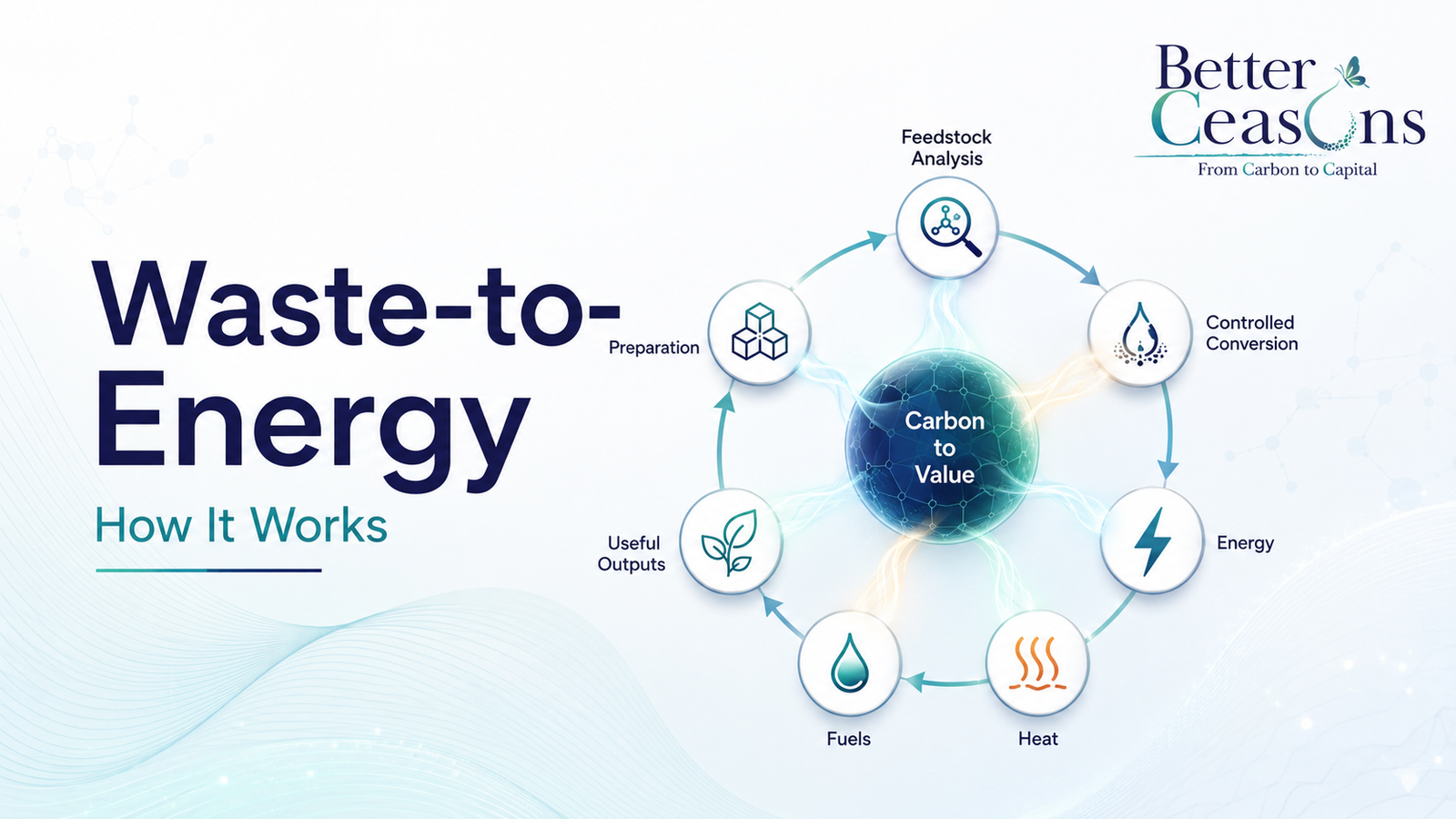
Waste to energy technology works when material science comes before machinery. First understand the waste. Then identify the appropriate conversion pathway. Prepare the feedstock. Control the process. Recover useful outputs. Manage residual material. Finally, compare the complete environmental result with the pathway the waste would otherwise have followed. The most important achievement is not that the waste changed form. It is that a difficult material moved towards a more responsible and useful destination.How Waste-to-Energy Technology Works
A step-by-step process for understanding how suitable waste can be prepared, converted and managed through waste-to-energy technology to create useful outputs.
Understand the waste feedstock
Identify the type of waste and assess characteristics such as moisture, energy content, organic composition, contaminants, particle size, chemical properties and consistency.
Select a suitable conversion technology
Choose a technology based on the characteristics of the feedstock rather than selecting equipment first. Different waste materials require different processing pathways.
Prepare the feedstock
Prepare the material through suitable preprocessing such as sorting, size reduction, drying, removal of incompatible components or blending where required.
Apply the appropriate conversion process
Process the suitable feedstock using an appropriate technology such as biological conversion, controlled thermal energy recovery, gasification or pyrolysis.
Control the operating conditions
Maintain suitable operating conditions for the selected technology so the process remains stable and appropriate for the material being treated.
Recover useful outputs
Identify and recover useful outputs such as electricity, heat, gaseous products, liquid fractions or suitable solid materials depending on the technology and feedstock.
Manage remaining material
Identify and responsibly manage residual outputs such as ash, char, process water, filtered material or unrecovered solids.
Evaluate the complete pathway
Compare the complete environmental and resource outcome with what would otherwise have happened to the waste, including useful outputs, emissions and residual materials.
Key Questions Answered
What is waste to energy technology?↓
It is a broad group of controlled processes that recover usable energy or other valuable outputs from suitable waste.
Can every waste type be converted into energy?↓
No. Different materials have different chemical and physical characteristics, so technology must be matched with suitable feedstock.
What is energy recovery from waste?↓
It means capturing usable energy from waste that still contains recoverable energetic value.
Is pyrolysis a waste-to-energy technology?↓
Pyrolysis can form part of a conversion or energy-recovery system for appropriate feedstocks, depending on the outputs and their final use.
Why is waste-to-energy research important?↓
Research tests whether a process remains safe, stable, efficient and useful when real waste variability and industrial operating conditions are introduced.
Written by Team Better Ceasons
Better Ceasons Editorial Team
Better Ceasons is a clean-technology enterprise transforming municipal solid waste streams into high-value carbon resources and renewable energy.
Explore Clean Tech Solutions
Better Ceasons has developed a solution that converts suitable plastic waste into fuel, supporting responsible resource recovery.
Explore Partnerships