
That description captures the central principle, but it leaves out most of what makes the process...
The pyrolysis process is often explained with four words. Heat without ordinary combustion. That description captures the central principle, but it leaves out most of what makes the process interesting. Real pyrolysis begins before material reaches the reactor. Feedstock needs to be understood. It may need sorting, drying or size adjustment. The reactor must maintain controlled conditions. Vapours and gases need to be managed. Condensable fractions need cooling. Solid material must be removed and characterised. The process does not end when the original feedstock disappears from view. It ends when every meaningful output has a responsible destination. Better Ceasons currently describes pyrolysis as a controlled thermochemical process in which suitable feedstock is transformed under little or no oxygen rather than burned in the ordinary way.
Everything begins with the feedstock
No serious pyrolysis process starts with the assumption that any material can be fed into the same machine. Feedstock composition determines behaviour. Biomass contains different chemical structures from plastic. Different plastics contain different polymers and additives. Moisture can change how much energy is required. Contaminants can affect product quality and process control. Particle size can influence heat transfer. This means feedstock screening is part of the technology itself.Preparation makes the material more predictable
Once suitable material has been identified, it may require preprocessing. Preparation can include sorting out incompatible material, reducing size, controlling moisture or creating a more consistent feed mixture. The objective is not cosmetic cleanliness. It is process stability. A reactor performs more predictably when the input remains within the range for which the system was designed. Better Ceasons currently includes feedstock identification, sorting and moisture conditioning among the early stages of its explanation of pyrolysis.The reactor creates the transformation environment
Prepared material then enters the pyrolysis reactor. The reactor is not simply a metal container that gets hot. Its role is to control the conditions around the feedstock. Heat must reach the material. Oxygen needs to remain absent or highly restricted according to process design. Temperature must remain within the required operating range. Residence time needs to suit the feedstock and desired outputs. Better Ceasons notes that reactor design and operating conditions must match the specific feedstock rather than assuming one reactor can manage every waste type.Heat begins breaking larger structures apart
As the material heats, its chemical structure starts changing. Volatile compounds leave the solid material. These become vapours and gases. A carbon-rich solid fraction remains. The proportions are not fixed. Feedstock composition, heating rate, temperature and residence time can change the balance between gaseous, liquid and solid outputs. This is why two pyrolysis plants handling different feedstocks should not be expected to produce identical products.Vapours move into downstream equipment
Once volatile material leaves the reactor, it enters another stage. Some vapours can be cooled until they condense into liquid fractions. Other components remain gaseous. The quality and composition of the resulting liquid depends on what entered the reactor and how the process operated. A liquid output is therefore not automatically a finished commercial product. It may require testing, separation, refining or other treatment before a particular use can be established.Non-condensable gases remain part of the system
Not everything condenses when cooled. A gaseous fraction can remain. Depending on its composition and process design, part of this gas may have energetic value. In some systems, suitable gas can contribute to process energy after appropriate treatment and control. The important point is integration. A gas should not be called useful merely because it burns. Its composition, handling, emissions and actual application all matter.Solid output remains inside the material balance
After volatile components leave, a solid carbon-rich fraction remains. When suitable plant-based biomass is processed, this is associated with biochar production. Better Ceasons currently discusses biochar as a stable carbon-rich output from appropriate biomass pyrolysis. For other feedstocks, the solid output may have a very different composition. Its potential use must therefore be established through testing rather than assumed from appearance.Plastic waste pyrolysis follows the same principle with different chemistry
Plastic waste pyrolysis attracts attention because many plastics contain hydrocarbon structures that can undergo thermal decomposition. But the category plastic includes numerous polymers, additives and composite materials. This changes process behaviour. A relatively consistent selected polymer stream is different from contaminated mixed packaging. Halogen-containing materials, additives and non-plastic contaminants can introduce additional technical considerations. This makes feedstock control particularly important. The process should fit the plastic, not the other way around.Pyrolysis is not ordinary burning
One of the most important distinctions is atmospheric condition. Combustion relies on oxygen. Pyrolysis operates with oxygen absent or highly restricted. That difference changes the chemical reactions taking place. Better Ceasons explicitly separates ordinary burning from pyrolysis technology on this basis. This is why describing pyrolysis as simply burning waste is technically incomplete. At the same time, describing it as automatically clean would also be incomplete. Engineering, emissions control, energy use and output management still determine environmental performance.Energy input has to be part of the assessment
Thermal conversion requires energy. That energy does not disappear from the environmental calculation. A useful evaluation should therefore ask where process energy comes from and whether suitable internally generated gases or heat can reduce external demand. The amount of energy required can also be influenced by feedstock moisture and preparation. A process that requires excessive energy to manage unsuitable material may not create the expected benefit.Output quality determines real value
Pyrolysis can produce material that looks promising in a laboratory. Commercial usefulness requires more. Outputs need specification. Consistency matters. Contaminants need to remain within acceptable limits for the intended use. A buyer or downstream process must actually exist. This is where the distinction between waste conversion and genuine resource recovery technology becomes important. Better Ceasons currently argues that transformation should be judged by useful outcomes, reduced burdens and net system improvement rather than by disappearance alone.The final comparison should be against the alternative
Pyrolysis should not be assessed in a vacuum. What would have happened to the feedstock otherwise? Would it have been physically recycled? Dumped? Stored? Burned without control? Landfilled? Would another recovery process have performed better? A responsible decision compares realistic alternatives. This is especially important when pyrolysis is discussed in relation to net zero. The environmental value depends on the complete system rather than the existence of a reactor.From input to output in one view
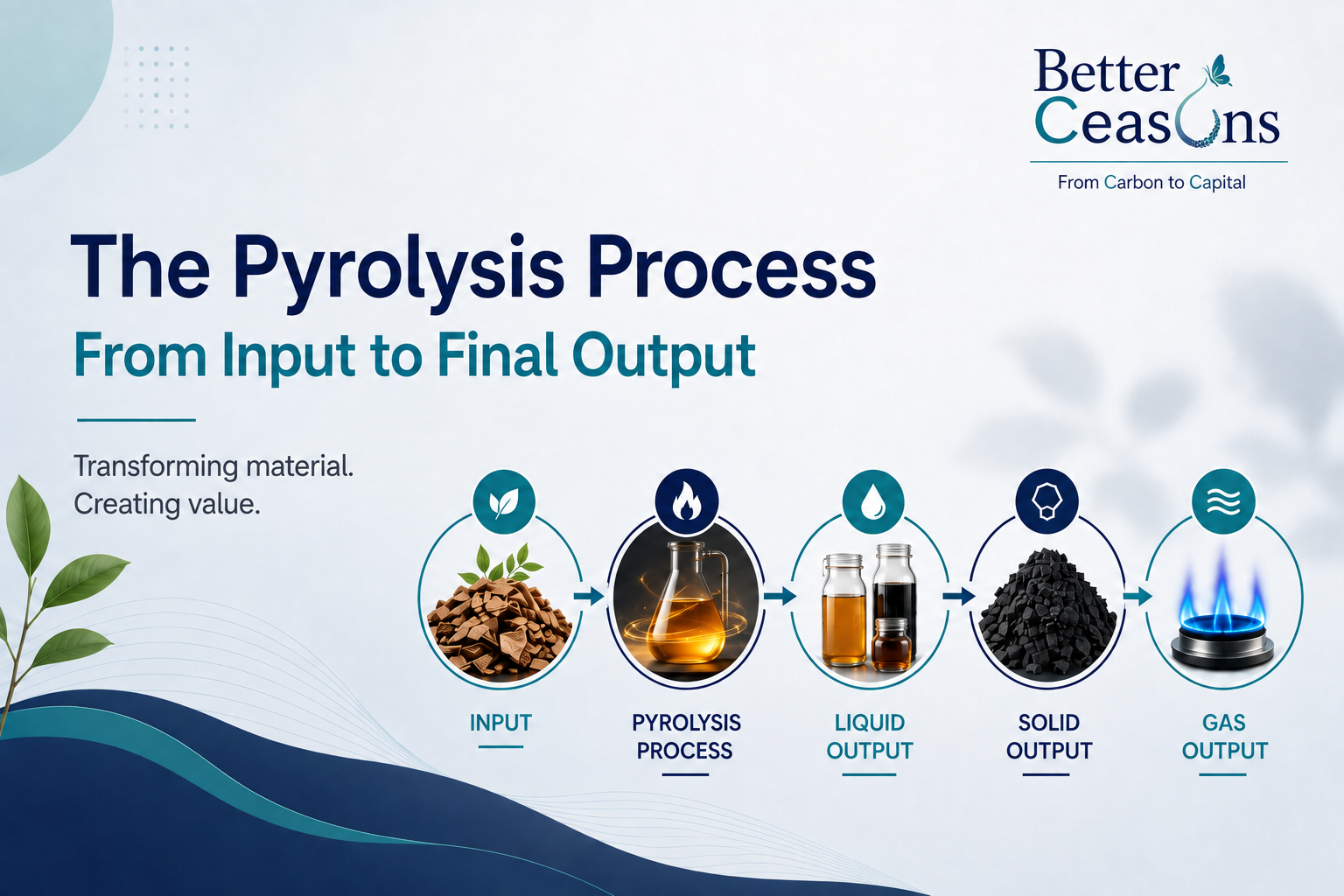
The process can be understood as a connected sequence. Suitable feedstock is identified. The material is prepared. It enters a controlled reaction environment. Heat causes thermochemical breakdown. Vapours and gases leave the solid material. Condensable fractions are cooled into liquids. Non-condensable gases are managed. Solid material is recovered. Each output is characterised and given an appropriate destination. Nothing about that sequence is magic. Its value lies precisely in understanding the transformation.Conclusion
The pyrolysis process begins with material knowledge and ends with output responsibility. The reactor may be the centre of the system, but it is not the whole system. Feedstock selection influences everything downstream. Preparation improves consistency. Heat changes the material. Vapour management shapes liquids. Gas handling affects energy and emissions. Solid recovery completes the material balance. A responsible pyrolysis process therefore asks more than whether waste can be transformed. It asks whether every stage creates a technically sound and environmentally better outcome.How the Pyrolysis Process Works From Input to Final Output
A step-by-step overview of how suitable feedstock is prepared, processed under controlled pyrolysis conditions and separated into gaseous, liquid and solid outputs.
Identify suitable feedstock
Assess the feedstock according to its composition, moisture, contaminants, particle size, polymers, additives and suitability for the intended pyrolysis system.
Prepare the feedstock
Prepare suitable material through processes such as sorting, size reduction, moisture control or creating a more consistent feed mixture.
Feed the material into the pyrolysis reactor
Introduce the prepared feedstock into a reactor designed to control temperature, heat transfer, residence time and atmospheric conditions.
Restrict oxygen and apply heat
Maintain little or no oxygen while heating the feedstock within the operating conditions required for thermochemical transformation.
Break down the feedstock thermochemically
As the material heats, larger chemical structures begin breaking down and volatile compounds separate from the remaining solid fraction.
Move vapours into downstream equipment
Direct volatile vapours and gases away from the reactor into downstream equipment for cooling, separation and further management.
Condense suitable vapours
Cool condensable vapours to produce liquid fractions that can then be tested, separated, refined or otherwise treated according to their intended use.
Manage non-condensable gases
Handle the remaining gaseous fraction according to its composition, process design, emissions requirements and potential energy application.
Recover the solid fraction
Remove and characterise the carbon-rich solid material remaining after volatile components have left the feedstock.
Characterise all final outputs
Test gaseous, liquid and solid outputs for composition, consistency, contaminants and suitability for their intended downstream applications.
Assign responsible destinations
Ensure every meaningful output has a technically suitable and environmentally responsible destination.
Compare the process with realistic alternatives
Evaluate the pyrolysis pathway against alternatives such as physical recycling, storage, landfill, uncontrolled burning or other recovery processes.
Key Questions Answered
What is the pyrolysis process?↓
It is the controlled thermochemical transformation of suitable material under little or no oxygen.
What are the main outputs of pyrolysis?↓
Depending on feedstock and operating conditions, outputs can include gaseous, condensable liquid and carbon-rich solid fractions.
Is pyrolysis the same as burning?↓
No. Ordinary combustion relies on oxygen, while pyrolysis occurs with oxygen absent or highly restricted.
Can all plastic waste undergo pyrolysis?↓
No. Feedstock chemistry, additives, contamination and reactor design determine suitability.
What is the role of the pyrolysis reactor?↓
The reactor creates and controls the thermal and atmospheric conditions needed for the feedstock to undergo thermochemical transformation.
Written by Team Better Ceasons
Better Ceasons Editorial Team
Better Ceasons is a clean-technology enterprise transforming municipal solid waste streams into high-value carbon resources and renewable energy.
Explore Clean Tech Solutions
Better Ceasons has developed a solution that converts suitable plastic waste into fuel, supporting responsible resource recovery.
Contact Better Ceasons