
Single use plastic creates a strange mismatch between usefulness and...
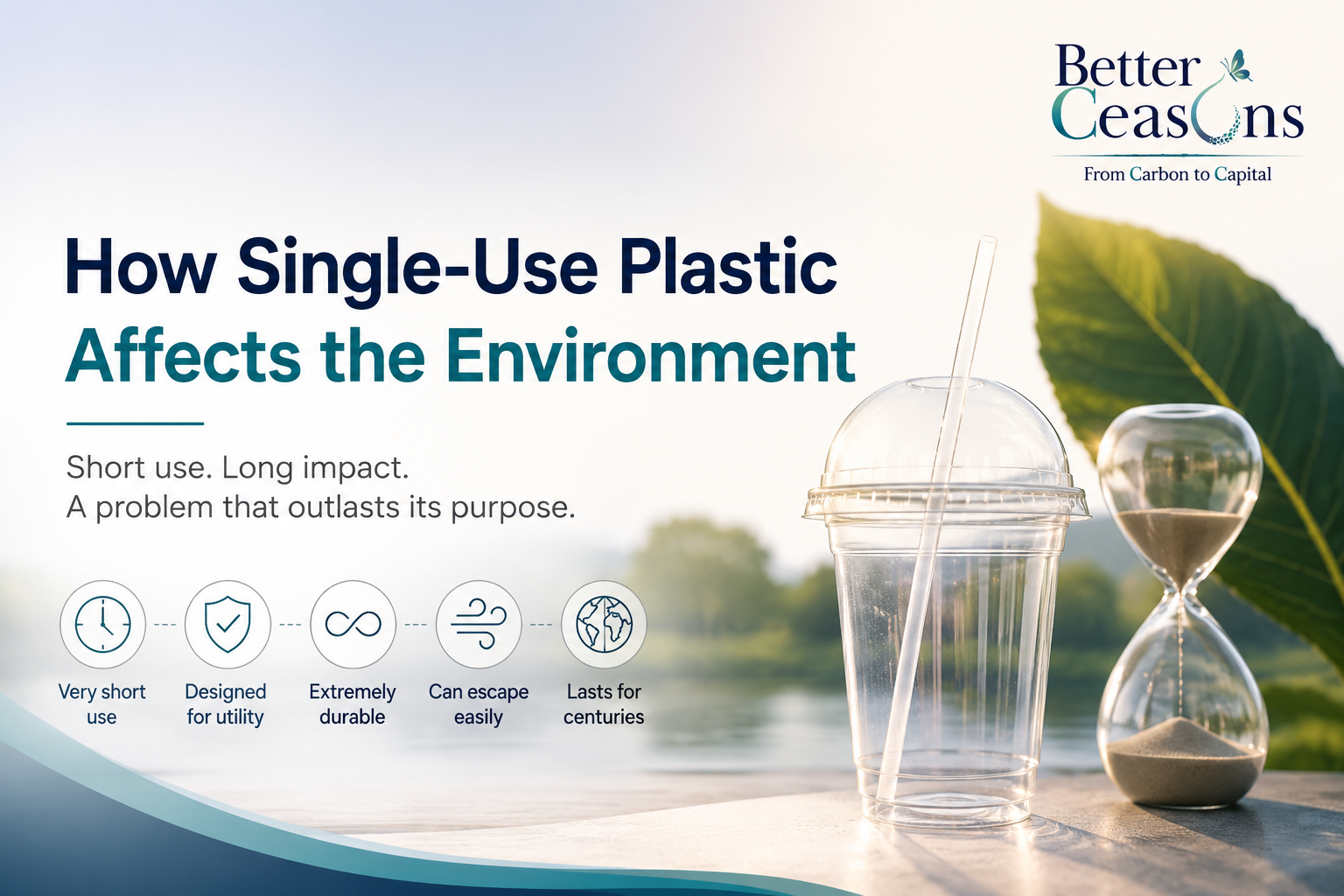
Single use plastic creates a strange mismatch between usefulness and lifespan. A wrapper may protect food for a few days and be opened in seconds. A takeaway container may be useful for the length of one meal. A protective film may perform an important role during transport and then immediately become waste. The material has done its job. The environmental story has not ended. This does not mean every single use application is unnecessary. Plastic can protect products, reduce contamination, provide hygiene barriers and prevent damage. The problem emerges when an extremely durable material enters a system designed around very short use and an uncertain afterlife.
The impact starts before disposal
When people think about plastic pollution, they usually picture what happens after the product is thrown away. The lifecycle begins much earlier. Resources are required to make polymers. Packaging is manufactured. Products are transported. Material is converted, printed and distributed. Energy is used across those stages. When a package is used once and discarded immediately, the material reaches the waste system very quickly relative to the time and resources invested in producing it. This is why the environmental impact of waste cannot be understood solely from what happens at the bin.The bin creates an illusion of disappearance
For most people, responsibility becomes less visible once collection happens. The wrapper is gone from the kitchen. The bag has left the office. The public bin has been emptied. But the material continues to exist. Better Ceasons builds its The Waste Illusion concept around this exact disconnect. Waste changes location and consequence rather than ceasing to exist when it leaves our view. Single use plastic makes this illusion particularly powerful because enormous numbers of small items can leave individual hands without anyone seeing their collective downstream journey.Packaging design can make recovery difficult
Some single use plastics are relatively simple. Others are engineered structures. A food package may combine several layers to protect against oxygen and moisture. Printing inks, labels, adhesives and barrier coatings may also be present. These features can be excellent for product protection while creating challenges after disposal. Multilayer plastic waste is therefore not difficult simply because consumers fail to separate it. Its complexity can be built into the package itself. This is a design and infrastructure problem as much as a behaviour problem.Contamination further narrows the options
Food packaging often reaches the waste system with residue still inside. Films can become mixed with wet waste. Lightweight plastic can collect dirt during handling. Once several materials and contaminants are combined, physical recycling becomes more difficult. Better Ceasons' current discussion of mixed waste treatment highlights variable composition, moisture, physical form and contamination as practical reasons real waste streams cannot always enter familiar recycling routes.Plastic can escape before reaching treatment
Light plastic items can travel easily when collection and containment fail. Wind can move films and wrappers. Drainage systems can carry small pieces. Uncontrolled dumping can place material directly into the wider environment. Over time, larger plastic items can fragment into smaller pieces. This means the environmental challenge is not restricted to formal disposal facilities. Leakage can occur anywhere between generation and final treatment.Landfill stores the problem rather than recovering the material
Plastic that reaches landfill may be contained more effectively than openly dumped plastic, but its remaining material value is usually not recovered through simple burial. Long-term disposal also occupies land and leaves the material outside productive use. This connects with wider concerns around landfill pollution and the tendency to treat removal as resolution. Better Ceasons' current Waste Illusion content argues that disposal should be evaluated according to what happens to the material after it leaves the original location.Single use plastic has a carbon dimension
Plastic waste is often discussed visually. The carbon story is less obvious. Energy has already been invested in production and transport. Waste collection and treatment can add additional energy use. If useful material is permanently lost, more raw material may be required for replacement products. That is why waste and climate change are connected even when the discarded item itself does not appear to be emitting anything. Better Ceasons currently describes the carbon footprint of waste as part of the material's complete lifecycle rather than only the final disposal stage.Reducing unnecessary use should come before end-of-life technology
The simplest waste is the waste that never needed to be created. Where product protection, safety and functionality allow, unnecessary single use material can be reduced. This does not mean automatically replacing plastic with a heavier or more resource-intensive alternative. Substitution should also consider lifecycle impact. The goal is not to remove a material from sight. It is to reduce the overall environmental burden.Reuse works when the system supports it
Reusable packaging can reduce repeated material consumption where the item is actually returned and reused enough times to justify the system. That requires infrastructure. Collection. Cleaning. Redistribution. Consumer participation. Transport. A theoretically reusable package that is commonly discarded after one use may not deliver the intended benefit. System behaviour matters as much as product design.Recycling remains useful for suitable streams
Clean, compatible plastic should not be excluded from established recycling pathways when those pathways can effectively manage it. The challenge is that single use plastic includes many materials that do not fit one simple category. That is why Better Ceasons does not treat sorting alone as the final answer. waste segregation at source can preserve material quality, but each separated stream still requires actual processing capacity.Difficult streams need credible alternatives
What happens to a plastic structure that cannot reasonably enter conventional recycling? This is where advanced waste processing, controlled conversion and other material-specific technologies become part of the discussion. The existence of an alternative technology does not mean every difficult plastic should automatically enter it. Feedstock suitability and environmental performance still matter. Better Ceasons' future of waste management concept currently emphasises matching individual waste streams with suitable solutions instead of relying on one universal answer.Better management begins with the full lifecycle
A single use plastic strategy should connect design and disposal rather than treating them as unrelated stages. Can unnecessary material be removed? Can the package become simpler without compromising its function? Can reuse work in that context? Can the material be collected cleanly? Is there a genuine downstream recycling route? If not, which controlled recovery process is technically suitable? What happens to its outputs? These questions are harder than putting one recycling symbol on a package. They are also more likely to produce meaningful change.Conclusion
Single use plastic affects the environment because a short-lived product can create a long material journey. Its impact does not begin when the wrapper becomes litter. It begins with production and continues through use, collection, transport, sorting, treatment and final destination. The response therefore needs more than one solution. Reduce what is genuinely unnecessary. Design better. Reuse where systems can support it. Recycle suitable material. Develop responsible pathways for difficult streams. Most importantly, follow the material beyond the bin. Only then can single use plastic be managed according to what actually happens rather than what we hope happens.How to Manage Single-Use Plastic More Responsibly
A lifecycle-based approach to reducing the environmental impact of single-use plastic through reduction, better design, reuse, recycling and responsible treatment.
Reduce unnecessary single-use plastic
Identify plastic that can be removed without compromising product protection, hygiene, safety or functionality.
Improve packaging design
Simplify packaging structures where possible and consider whether multilayer materials, coatings, adhesives and labels make recovery more difficult.
Consider reuse where practical
Use reusable packaging where collection, cleaning, redistribution, transport and consumer participation can support repeated use.
Segregate suitable plastic streams
Keep suitable plastic materials separated and as clean as possible so their quality is preserved for downstream processing.
Recycle compatible materials
Send clean and compatible plastic materials to established recycling pathways where suitable processing capacity is available.
Evaluate difficult plastic streams
Assess contaminated, mixed or multilayer plastic according to its composition, physical form and available treatment options.
Choose suitable treatment methods
Consider controlled conversion or other material-specific technologies when conventional recycling is not technically suitable.
Evaluate the full lifecycle
Consider production, use, collection, transport, sorting, treatment and final destination when assessing the environmental impact of single-use plastic.
Key Questions Answered
Why is single use plastic an environmental problem?↓
Its use period can be extremely short while the material may remain in waste systems or the environment for much longer.
Can all single use plastic be recycled?↓
No. Polymer type, contamination, multilayer structures and local processing capability influence recyclability.
Does single use plastic contribute to carbon emissions?↓
Its lifecycle can involve emissions during material production, transport, waste collection and treatment.
Is replacing all plastic automatically better?↓
Not necessarily. Alternative materials also have production, transport and end-of-life impacts that should be considered.
What is the most effective way to manage single use plastic?↓
A combination of unnecessary-use reduction, better design, reuse where practical, suitable recycling and responsible treatment of difficult residual streams is generally more realistic than one universal solution.
Written by Team Better Ceasons
Better Ceasons Editorial Team
Better Ceasons is a clean-technology enterprise transforming municipal solid waste streams into high-value carbon resources and renewable energy.
Explore Clean Tech Solutions
Better Ceasons has developed a solution that converts suitable plastic waste into fuel, supporting responsible resource recovery.
Contact Better Ceasons