
A company can know exactly how many tonnes of waste it produces and still know surprisingly little about the climate impact of that...
A company can know exactly how many tonnes of waste it produces and still know surprisingly little about the climate impact of that waste. Weight tells us how much material moved. It does not tell us what the material was, where it went, how far it travelled, how it was treated, or what happened afterwards. That is why calculating the carbon footprint of waste requires more than adding up disposal records. A useful calculation follows the journey. Better Ceasons currently defines this carbon story broadly, connecting waste with production, transportation, handling, treatment and final outcome.
Begin by defining the boundary
Every carbon calculation needs a clear starting and ending point. A business may want to calculate only emissions associated with the treatment of waste generated during its operations. A waste-management company may need a wider boundary, including collection vehicles, facility electricity, and treatment processes. A project comparison may measure the difference between the current waste pathway and a proposed alternative. None of these boundaries is automatically wrong. The problem occurs when the boundary is unclear. Before gathering numbers, write down exactly which stages are included.Measure how much waste is generated
The next requirement is activity data. Measured weights are generally more useful than broad visual estimates when scales or reliable records are available. Waste should also be separated into meaningful material categories. One hundred tonnes of mixed municipal waste should not automatically receive the same assumptions as one hundred tonnes of plastic, food waste or metal. Material composition influences treatment and emissions. The more accurately the waste is understood, the more useful the carbon result becomes.Record where every material goes
This is often where waste carbon calculations become difficult. Organizations may know which contractor removed the material but not what happened after the vehicle left. Try to identify the actual treatment route.Was the material recycled?
Composted?
Digested?
Sent for energy recovery?
Landfilled?
Processed through another conversion technology?
The answer matters because the same material can produce different carbon outcomes under different treatment conditions.Choose suitable emission factors
At its simplest, a waste carbon calculation often follows a relationship such asquantity of waste multiplied by the relevant emission factor
The difficulty lies in choosing the relevant factor. The factor should match the material, treatment method, geography and calculation methodology as closely as reasonably possible. Mixing factors from incompatible methodologies can make the final number look more accurate than it really is. Document the source and year of every factor used. This makes the calculation easier to review and update later.Include transport when it belongs inside the boundary
A treatment facility does not tell the whole story if waste travelled a long distance to reach it. Transport calculations can consider distance, quantity moved, vehicle type and fuel or energy use depending on data availability. Repeated transfers should also be visible where they are material. Better Ceasons includes transportation and repeated handling within its current explanation of carbon emissions from waste. This matters because poor logistics can quietly increase the footprint of an otherwise useful recovery route.Consider methane for biodegradable waste
Organic material needs particular attention. When suitable organic matter decomposes under conditions with very little oxygen, methane can form. This makes methane emissions from waste relevant to certain disposal and treatment pathways. The carbon calculation should use an accepted treatment-specific methodology rather than applying one generic methane assumption to every organic stream. How material is managed changes the result.Keep actual emissions and avoided impacts separate
Suppose a waste treatment system recovers material that replaces part of the demand for virgin raw material. Or suppose a conversion process produces useful energy that substitutes for another source. These benefits may be relevant to the comparison. But they should be presented clearly. Operational emissions are what the waste pathway itself creates. Avoided emissions represent a comparison with what would otherwise have happened. Combining the two without explanation can make it difficult to understand the real performance of the system. Transparency is more valuable than an impressive headline number, especially when distinguishing direct carbon reduction and carbon offsetting within corporate reporting.Build a baseline before claiming improvement
A carbon reduction needs something to be reduced from. Establish the current waste pathway first. Then model the alternative. For example, the existing system may involve collection, two transfer stages and landfill. A proposed system may involve source separation, a shorter transport route and a recovery facility. Calculate both using comparable boundaries. Only then does the difference become meaningful. This baseline thinking is essential to serious net zero waste management. Better Ceasons currently frames net-zero waste management around reducing avoidable emissions while measuring the complete lifecycle effect rather than looking at a single point in isolation.Avoid false precision
Waste data is messy. Composition estimates may be imperfect. Contractors may provide average treatment data. Transport records may be incomplete. Material may occasionally be sent to a different destination. Do not hide these uncertainties behind six decimal places. Record assumptions. Identify which data is measured and which is estimated. Use sensitivity analysis where one uncertain assumption has a large effect on the result. A carbon footprint becomes more credible when the reader can see its limitations.Use the calculation to find hotspots
The purpose of carbon accounting is not simply reporting. It should reveal where improvement is possible. Perhaps collection vehicles are travelling half full. Perhaps a mixed waste stream prevents useful material from being recovered. Perhaps one distant treatment route adds excessive transport. Perhaps biodegradable waste is entering an inappropriate long-term disposal pathway. Perhaps poor storage creates additional handling. Once hotspots are visible, operational changes can be prioritised according to impact. This is where the relationship between waste and climate change becomes practical rather than abstract.Update the calculation as the system improves
A carbon footprint is a snapshot. Waste systems change. Volumes increase or decrease. Suppliers change. Treatment facilities improve. Electricity sources evolve. Recovery rates change. The calculation should therefore be updated periodically using consistent methodology. Over time, this creates something more valuable than a one-off number. It creates a trend.A simple calculation framework
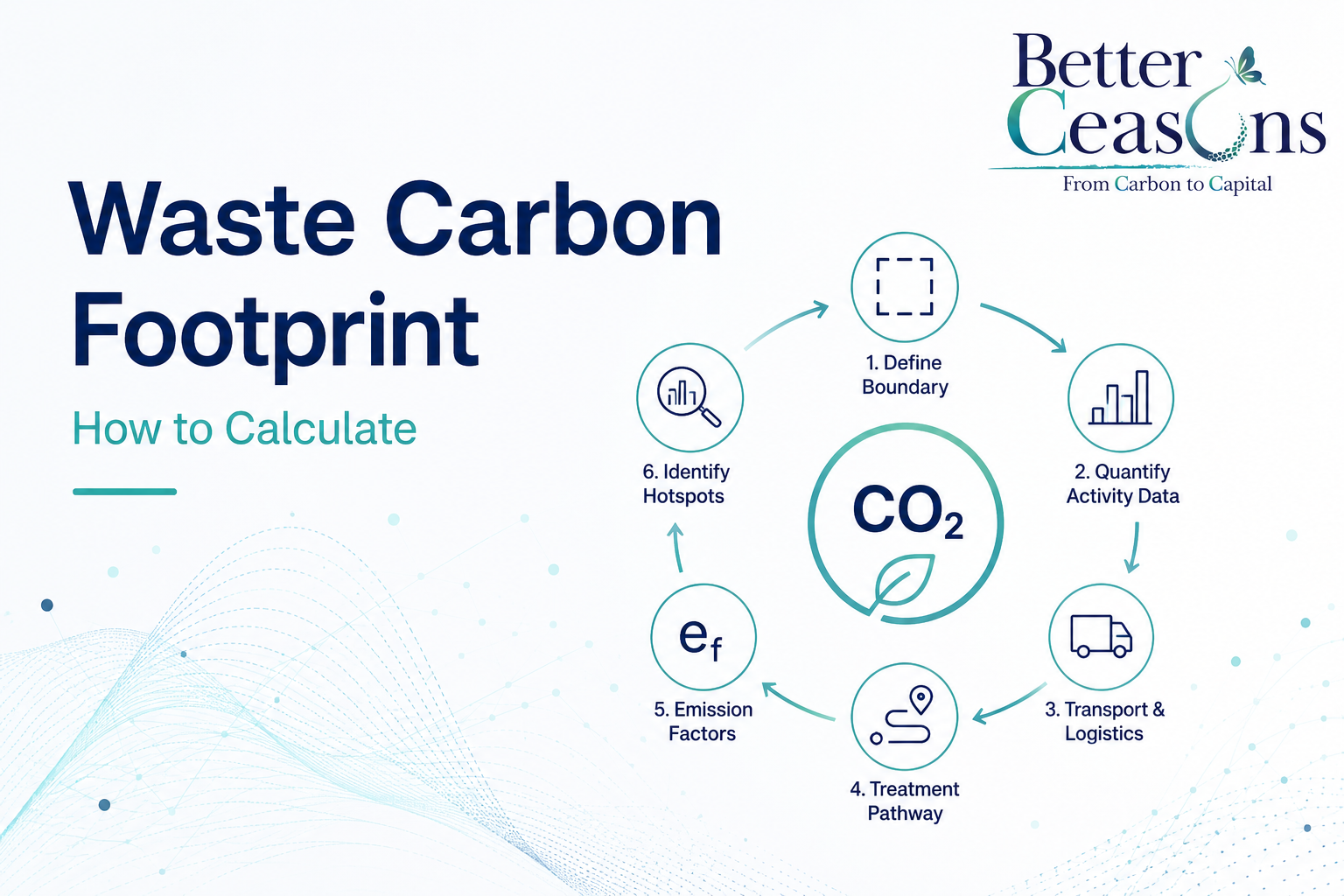
For most organisations, the process can be summarised in seven steps. Define the organisational and lifecycle boundary. Measure waste quantities by meaningful material category. Confirm the treatment destination for each stream. Collect transport and operational data where required. Apply credible material and treatment-specific emission factors. Separate direct pathway emissions from comparative avoided impacts. Review hotspots and calculate realistic reduction scenarios. This framework will not replace a detailed lifecycle assessment where one is required, but it creates a far stronger starting point than applying one average carbon number to total waste tonnage.Conclusion
Calculating the carbon footprint of waste is ultimately an exercise in following material. The numbers become credible only when the waste journey becomes visible. Know what was discarded. Know how much. Know how it moved. Know how it was treated. Know what happened to the outputs. Then apply a consistent carbon methodology. A good waste carbon footprint does more than produce a figure for a sustainability report. It reveals where waste decisions are creating unnecessary emissions and where a different pathway could produce a better result.How to Calculate a Waste Carbon Footprint
A seven-step framework for calculating the carbon footprint of waste by defining the assessment boundary, measuring waste, identifying treatment routes, collecting transport data, applying emission factors and reviewing reduction opportunities.
Define the organisational and lifecycle boundary
Decide which stages of the waste journey will be included in the calculation, such as collection, transportation, handling, treatment and final outcome.
Measure waste quantities by material category
Measure how much waste is generated and separate it into meaningful categories such as plastic, food waste, metal or mixed municipal waste.
Confirm the treatment destination
Identify what happens to each waste stream after collection, including recycling, composting, digestion, energy recovery, landfill or another conversion pathway.
Collect transport and operational data
Record relevant transportation and operational information such as distance travelled, quantity moved, vehicle type, repeated transfers and energy use where these fall within the calculation boundary.
Apply suitable emission factors
Apply credible emission factors that match the material, treatment method, geography and calculation methodology as closely as reasonably possible.
Separate actual emissions from avoided impacts
Report operational emissions separately from avoided or comparative emissions associated with recovered materials, energy or other useful outputs.
Review hotspots and reduction scenarios
Analyse the results to identify significant emission sources and compare realistic alternatives that could reduce the waste carbon footprint.
Key Questions Answered
What is the carbon footprint of waste?↓
It is the greenhouse gas impact associated with the lifecycle and end-of-life management of discarded material.
What information is needed to calculate it?↓
Useful data includes waste type, quantity, treatment route, transport activity and relevant emission factors.
Should transport emissions be included?↓
Yes when transportation falls within the defined calculation boundary.
Does every tonne of waste have the same footprint?↓
No. Material composition and treatment pathway can substantially change the result.
How often should a waste carbon footprint be recalculated?↓
Organisations commonly review carbon inventories periodically so changes in waste volume, treatment and operations can be reflected consistently.
Written by Team Better Ceasons
Better Ceasons Editorial Team
Better Ceasons is a clean-technology enterprise transforming municipal solid waste streams into high-value carbon resources and renewable energy.
Explore Clean Tech Solutions
Better Ceasons has developed a solution that converts suitable plastic waste into fuel, supporting responsible resource recovery.
Explore Partnerships