
The pyrolysis reactor is where one of the most important changes in the entire pyrolysis system takes...
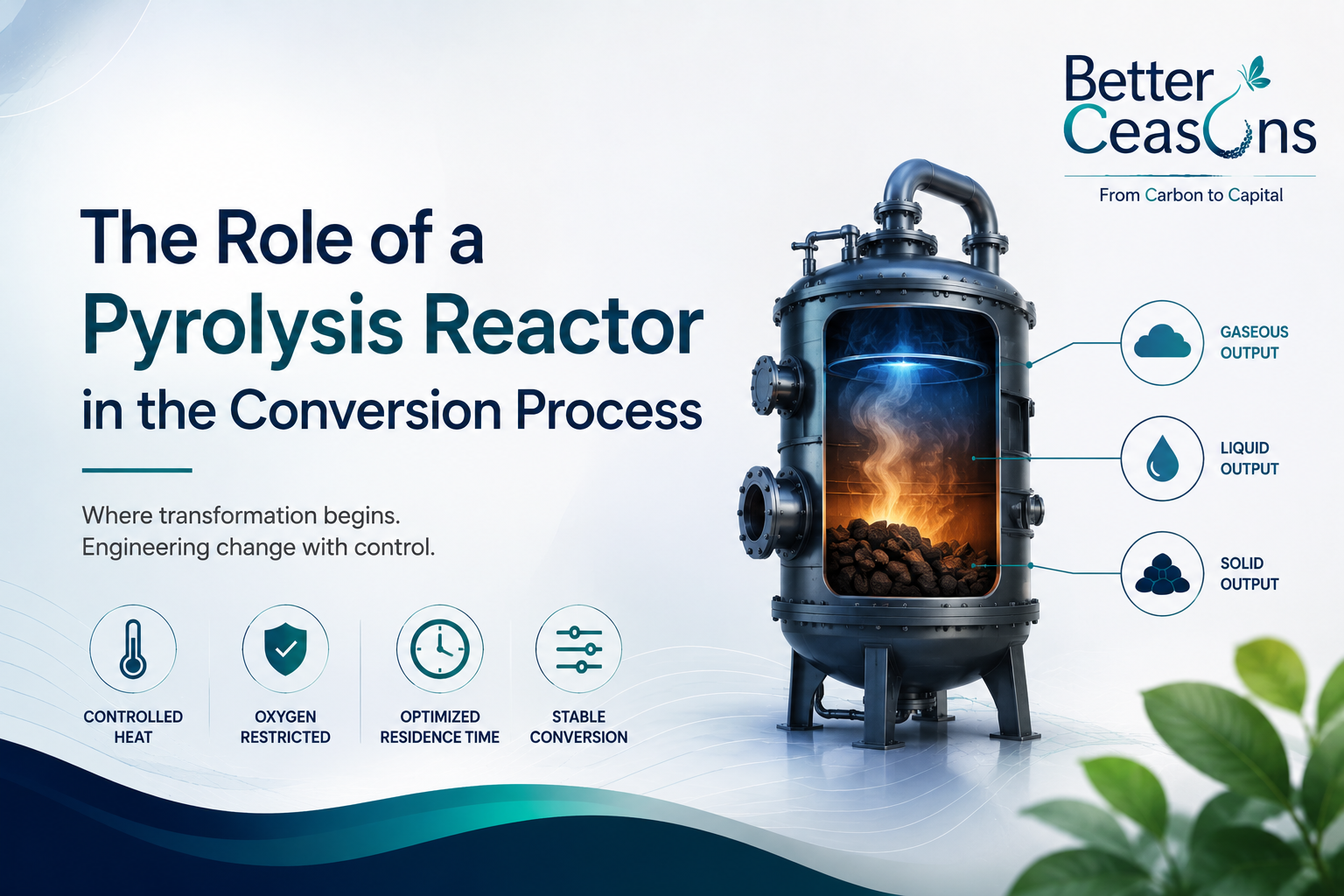
The pyrolysis reactor is where one of the most important changes in the entire pyrolysis system takes place. Material enters in one chemical form. Controlled heat begins changing it. Vapours leave. Gases form. Solid material remains. Yet describing the reactor as simply the place where waste is heated misses much of its engineering purpose. A reactor is responsible for creating an environment in which thermal decomposition can happen predictably. Better Ceasons currently defines it as the specialised enclosed vessel that maintains the thermal and atmospheric conditions necessary for controlled thermochemical transformation.
The reactor separates pyrolysis from ordinary burning
The first task of the reactor is atmospheric control. Ordinary combustion relies on oxygen. The pyrolysis process takes place when oxygen is absent or highly restricted. That changes what happens to the feedstock. Instead of primarily supporting combustion, the reactor creates conditions for thermal decomposition. Maintaining this environment requires proper design, sealing, feeding and process control. It cannot be achieved reliably by simply placing material inside any heated container.Heat needs to reach the material effectively
Temperature alone does not explain reactor performance. Heat must actually move into the feedstock. If parts of the material remain too cool while others overheat, conversion can become inconsistent. Particle size, feed rate, mixing and reactor geometry can all influence heat transfer. Different reactor designs address this challenge in different ways. This is why a reactor suitable for one feedstock or operating objective may be unsuitable for another.Residence time changes the process
Material spends a certain amount of time inside the reaction environment. Vapours may also remain within hot zones for particular periods. These residence times influence how far thermal reactions proceed. Shorter or longer exposure can change the balance and characteristics of products. Residence time therefore interacts with temperature and heating rate rather than functioning as an independent setting. Good reactor operation manages these variables together.Feedstock determines reactor requirements
The same reactor should not be assumed to handle every type of material. Biomass pyrolysis involves plant-based material with characteristics different from plastic. Selected plastic waste pyrolysis feedstock contains different hydrocarbon structures and additives. Moisture may differ. Bulk density differs. Ash behaviour differs. Potential contaminants differ. Reactor design and residence time need to be matched with the feedstock for which the system is engineered. That is one of the most important concepts in pyrolysis engineering.Feeding material is part of reactor control
Getting feedstock into the reactor sounds simple. In practice, the feeding system can affect air ingress, throughput and process stability. Material needs to enter without disrupting the controlled internal environment. Feed rate should also remain within the range the reactor can handle. An inconsistent feed can cause temperatures and vapour production to fluctuate. This is why preparation and feeding equipment should be seen as part of the reactor system rather than unrelated accessories.The reactor begins separating one material into several outputs
As thermal decomposition progresses, volatile compounds leave the feedstock. These exit as hot vapours and gases. A solid carbon-rich fraction remains. The reactor therefore performs a chemical separation through transformation. Downstream systems then handle each fraction. Condensers cool selected vapours. Gas-cleaning or gas-handling equipment manages gaseous fractions. Solid-handling equipment removes remaining material. The reactor is central, but the conversion process continues well beyond it.A reactor does not create a finished product by itself
This distinction matters commercially. The material leaving a reactor may require several additional processing steps before it can be considered useful. Condensed liquid may need separation or upgrading. Gas may require cleaning. Solid output may need cooling, testing or refinement. The value of a pyrolysis technology system therefore depends on downstream integration as well as reactor performance.Temperature stability affects consistency
Commercial users need outputs they can understand. If reactor conditions change sharply between batches, output composition may also change. Stable temperature and feed conditions can support more predictable products. This is one reason automation and instrumentation are important in modern reactor systems. Operators need visibility into key process variables rather than relying on guesswork. Control is the difference between engineered transformation and uncontrolled heating.Reactor materials need to suit operating conditions
The internal environment of a reactor can be demanding. High temperatures, feedstock chemistry and process gases can affect equipment materials over time. This is why reactor design and residence time need to be considered alongside feedstock characteristics. Reactor construction cannot be treated as a generic fabrication exercise. Material selection should reflect operating temperature, process chemistry, expected lifetime and maintenance requirements.Energy integration can change overall performance
A reactor requires thermal energy. Where appropriate, parts of the produced gas may potentially contribute to process heat after suitable treatment and system design. Heat can sometimes be recovered elsewhere in the plant. Good integration can reduce external energy demand. Poor integration can make an otherwise interesting conversion process unnecessarily energy-intensive. Reactor efficiency should therefore be considered inside the larger plant energy balance.Safety comes from controlled engineering
High-temperature equipment and potentially combustible process gases require careful engineering. Pressure management, feeding, gas handling, instrumentation, shut-down procedures and emissions controls all contribute to safe operation. The phrase controlled conversion should be taken literally. A reactor is useful because it creates defined conditions and keeps the process within them.The reactor cannot fix unsuitable feedstock
One of the most important limits of reactor technology is also one of the easiest to ignore. A well-designed reactor cannot make every feedstock appropriate. If material contains substances incompatible with the process, reactor sophistication does not remove that fundamental issue. Feedstock analysis therefore needs to happen before conversion. This reinforces Better Ceasons' broader future of waste management perspective that different streams need different pathways and no single machine can solve every waste problem.Scale changes reactor challenges
Laboratory reactors allow researchers to study material behaviour under controlled conditions. Commercial equipment must do the same thing continuously or repeatedly at much larger throughput. Heat transfer becomes more difficult. Feeding becomes more demanding. Maintenance becomes more important. Output handling grows. Small variations in efficiency can become significant when tonnes of material are processed. This is why waste to energy research and industrial testing remain important before technologies reach commercial scale. Better Ceasons' Partners in Change page currently emphasises the importance of moving research from laboratory possibility towards dependable industrial practice.The reactor is the heart, not the whole body
It is reasonable to call the reactor the heart of a pyrolysis plant. But a heart cannot function without the rest of the system. Feedstock preparation determines what enters. Feeding systems control how it enters. The reactor performs thermal transformation. Condensation and gas treatment manage volatile outputs. Solid handling manages remaining material. Instrumentation controls the process. Output applications create the final value. Every one of these steps influences whether the plant creates a responsible outcome.Conclusion
The role of a pyrolysis reactor is to create the controlled environment where suitable feedstock undergoes thermochemical transformation. It manages heat. Restricts oxygen. Controls residence time. Supports the formation of vapour, gas and solid fractions. But reactor performance cannot be judged alone. The feedstock needs to be appropriate. Downstream systems need to recover and manage outputs. Energy use needs to be understood. Residues need responsible destinations. The reactor is where the chemical change begins. The complete system determines whether that change becomes useful.How a Pyrolysis Reactor Works in the Conversion Process
A step-by-step overview of how a pyrolysis reactor creates controlled thermal and atmospheric conditions to transform suitable feedstock into vapour, gas and solid fractions.
Analyse the feedstock
Assess the feedstock for composition, moisture, bulk density, contaminants, additives and other characteristics that affect reactor suitability.
Prepare the feedstock
Prepare the material so that particle size, moisture and composition remain within the operating range for which the reactor is designed.
Feed material into the reactor
Introduce the prepared feedstock through a controlled feeding system that limits unwanted air ingress and maintains stable throughput.
Restrict oxygen
Maintain an environment where oxygen is absent or highly restricted so that thermal decomposition occurs instead of ordinary combustion.
Apply controlled heat
Transfer heat effectively into the feedstock while managing temperature, feed rate, reactor geometry and other variables that influence conversion.
Control residence time
Manage how long the feedstock and vapours remain under reaction conditions because residence time interacts with temperature and heating rate.
Allow thermochemical transformation
As the feedstock decomposes thermally, volatile compounds leave as hot vapours and gases while a solid carbon-rich fraction remains.
Move vapours and gases downstream
Direct volatile outputs to downstream equipment such as condensers and gas-handling systems for cooling, separation and treatment.
Recover the solid fraction
Remove the remaining solid material using appropriate handling equipment and prepare it for cooling, testing or further processing.
Monitor reactor conditions
Use instrumentation and process controls to monitor temperature, pressure, feeding, gas handling and other important operating variables.
Manage energy integration
Assess whether suitable produced gases or recovered heat can contribute to process energy while maintaining appropriate treatment and control.
Evaluate downstream outputs
Test and manage liquid, gaseous and solid outputs so that each fraction has a technically suitable and responsible destination.
Key Questions Answered
What is a pyrolysis reactor?↓
It is an enclosed engineered vessel where suitable feedstock is heated under little or no oxygen to enable thermochemical transformation.
Why is oxygen restricted inside the reactor?↓
Restricting oxygen prevents the process from becoming ordinary combustion and enables pyrolytic decomposition.
Can one pyrolysis reactor process every type of waste?↓
No. Reactor design and operating conditions need to match the characteristics of the intended feedstock.
What comes out of a pyrolysis reactor?↓
Hot vapours, gases and a solid fraction can emerge, with exact proportions depending on feedstock and process conditions.
Why does residence time matter?↓
The time material and vapours spend under reaction conditions influences the extent and nature of thermal conversion.
Written by Team Better Ceasons
Better Ceasons Editorial Team
Better Ceasons is a clean-technology enterprise transforming municipal solid waste streams into high-value carbon resources and renewable energy.
Explore Clean Tech Solutions
Better Ceasons has developed a solution that converts suitable plastic waste into fuel, supporting responsible resource recovery.
Contact Better Ceasons