Plastic supports almost every part of modern life. It protects food, keeps medicines safe, reduces product weight, and helps goods move efficiently...
Plastic supports almost every part of modern life. It protects food, keeps medicines safe, reduces product weight, and helps goods move efficiently through supply chains. Its durability makes it useful during use, but that same quality creates a serious challenge after disposal. Plastic waste does not disappear when the collection vehicle drives away. It enters a hidden journey shaped by product design, contamination, sorting quality, infrastructure, and available technology. What happens next depends on what the plastic contains, how it has been used, what other materials are attached to it, and which treatment systems are available. This is why plastic waste management methods and solutions cannot depend on one bin, one sorting process, or one technology. Better Ceasons focuses on the conversion of plastic streams that often remain difficult to manage after collection and sorting. By studying the material and applying controlled conversion technology, Better Ceasons creates a practical pathway for turning suitable plastic waste into fuel.
Why Plastic Waste Is Difficult to Manage
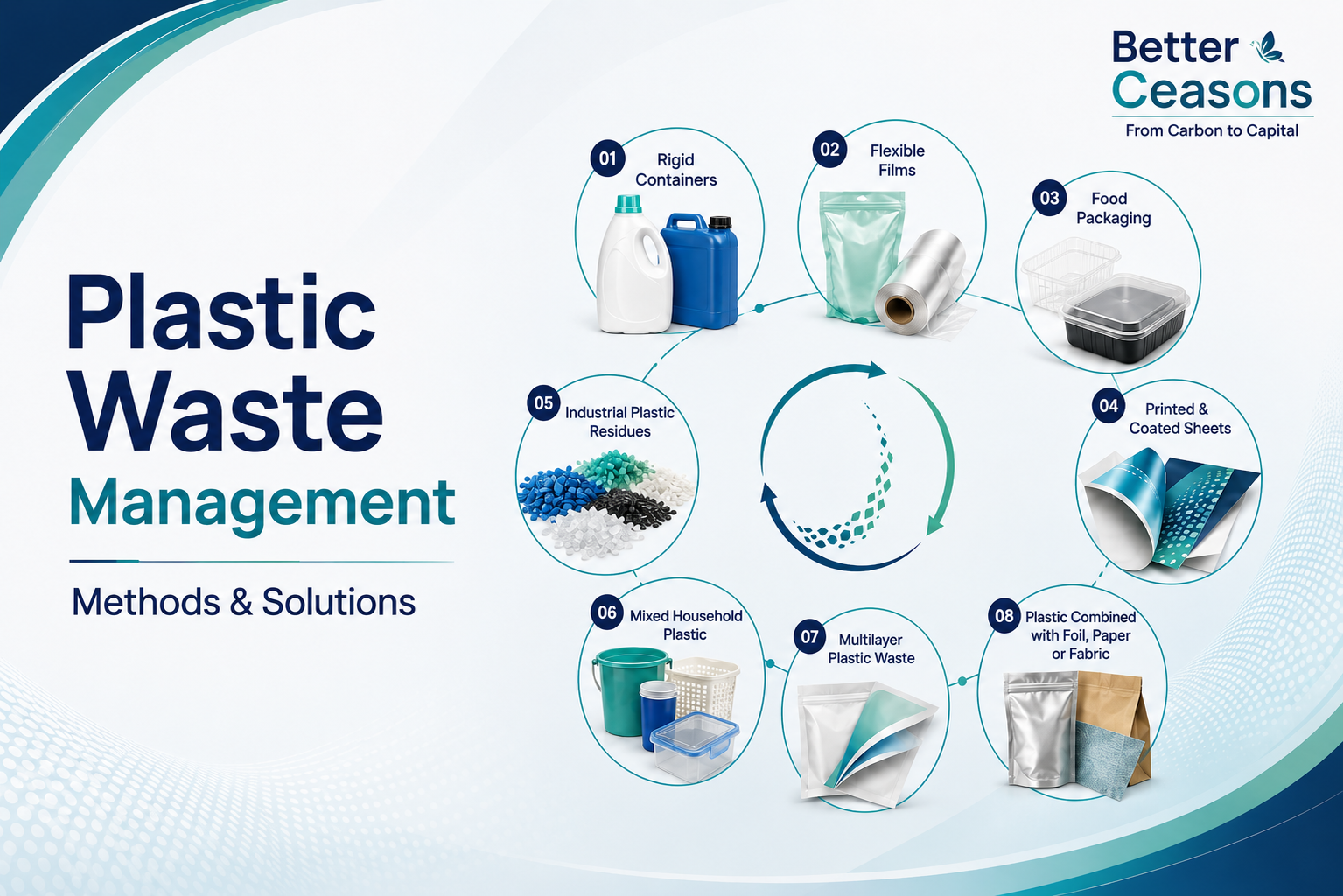
Plastic waste is often discussed as though it were one single material. In reality, plastic waste can include many different polymers, formats, coatings, combinations, and contamination levels. It may include:Rigid containers
Flexible films
Food packaging
Printed and coated sheets
Industrial plastic residues
Mixed household plastic
Multilayer plastic waste
Plastic combined with foil, paper, fabric, adhesives, or other materials
Each material behaves differently during sorting, preparation, and treatment. A clean rigid plastic container may be relatively straightforward to identify and prepare. A food stained packet may require additional handling. Thin flexible films can become tangled in sorting equipment. Multilayer packaging may contain several plastic types, adhesives, inks, metallic layers, and protective coatings within a single product. These differences can influence sorting accuracy, preparation requirements, treatment temperature, process stability, output quality, and technology selection. Responsible plastic waste management therefore begins with understanding the material before deciding how it should be processed. For commercial operations, learning how businesses can improve plastic waste management is an essential first step toward responsible material stewardship.What Happens to Plastic After Collection?
Collection is only the beginning of the plastic waste journey. After collection, plastic may first reach a transfer station where material from several collection vehicles is combined before being transported in larger quantities. From there, it may move to a sorting facility. Sorting facilities can use conveyor systems, rotating screens, optical scanners, air separation, density separation, and manual inspection to separate plastic from glass, metal, organic material, paper, and other waste streams. These systems play an important role, but they also have practical limitations. An optical scanner may identify the visible surface of a package without fully understanding the different layers bonded inside it. Food stained plastic may be rejected. Small plastic fragments may remain mixed with other materials. Flexible packaging can fold, overlap, or become trapped in equipment. Collection moves plastic from one location to another. Sorting organises it into more useful categories. Neither step automatically guarantees that the material has reached an appropriate final treatment pathway.Why Sorting Alone Is Not Enough
Separating broad material categories can improve the quality of collected plastic. Keeping organic residue away from dry material can also reduce contamination and make further treatment easier. But sorting does not solve every waste segregation problem. Even after plastic has been separated, important questions remain.Which facility can actually accept the material?
Can the facility manage its contamination level?
Is enough material available to justify transportation and processing?
What happens to mixed or multilayer packaging?
Can the resulting output be used practically?
How will remaining residues be managed?
Is suitable treatment infrastructure available nearby?
A separated plastic stream can still contain several polymers, labels, inks, adhesives, coatings, and food residue. A processing facility may accept one plastic category while rejecting another. Some regions may have collection and segregation infrastructure but limited capacity for handling difficult plastic streams. This is why waste segregation alone is not enough when mixed, contaminated, or multilayer plastic still requires a practical destination. Sorting remains important, but every sorted material stream needs a technically suitable next step.Why Multilayer Plastic Is a Major Challenge
Multilayer packaging is designed to perform several functions at the same time. One layer may provide structural strength. Another may prevent moisture from entering. A metallic layer may protect food from oxygen or light. Adhesives keep different layers bonded together, while printing inks and coatings provide branding, protection, and product information. This creates highly effective packaging during use. After disposal, however, the same structure becomes difficult to process. Multilayer plastic waste may contain:Several plastic types
Aluminium foil
Paper
Adhesives
Printing inks
Protective coatings
Food contamination
These materials can be tightly bonded together. Separating individual layers through conventional physical processes may require specialized equipment, considerable preparation, and additional energy. In many cases, separation may not be technically or economically practical. Multilayer packaging can also be lightweight and flexible, which makes consistent sorting more difficult. This does not necessarily mean that the material has no remaining value. It means the correct plastic waste solutions must be selected according to the actual characteristics of the material instead of assuming that every plastic stream can follow the same processing route.Main Plastic Waste Management Methods
There is no universal treatment method for every plastic stream. The appropriate pathway depends on material composition, contamination, product design, available infrastructure, technology compatibility, and the intended output.1. Reducing Unnecessary Plastic
Effective plastic waste management can begin before waste is created. Businesses can reduce unnecessary material by removing excessive packaging, simplifying material combinations, avoiding unnecessary decorative layers, and limiting disposable components that provide little functional value. This does not mean eliminating plastic from every application. Plastic continues to perform valuable functions in healthcare, food preservation, logistics, construction, transportation, and industrial safety. The objective is to avoid unnecessary material wherever practical while retaining plastic where its properties provide genuine value.2. Extending Product Life
Some plastic products can remain useful for longer periods. Durable crates, storage containers, industrial pallets, refillable packaging, and similar products may reduce the need for repeated production when effective return and reuse systems are available. However, a durable product does not automatically become reusable. Successful reuse requires collection points, cleaning, inspection, storage, reverse logistics, tracking, and participation from businesses or consumers. Product life extension works best when the surrounding system is designed to support it.3. Physical Plastic Processing
Suitable plastic streams may be identified, cleaned, shredded, melted, and reshaped into new material or products. Physical processing is generally more suitable when the incoming material is relatively clean and its plastic composition can be identified with reasonable consistency. Input quality has a major influence on output quality. Different polymers behave differently when exposed to heat. Moisture, food residue, oils, colours, fillers, and additives may also influence processing performance and the consistency of the resulting material. Physical processing can therefore be valuable for selected plastic streams, but it may become more difficult when materials are mixed, heavily contaminated, coated, or multilayered.4. Chemical Conversion
Chemical conversion changes the molecular structure of plastic rather than simply changing its physical form. Depending on the technology and input material, the process may generate gases, liquid components, oils, wax like materials, or chemical feedstocks. These outputs may require additional treatment before they can be used. A chemical conversion process should therefore be assessed according to practical questions such as:Which plastic types can the process accept?
How much contamination can it tolerate?
What preparation does the feedstock require?
What gases or residues are generated?
What output quality can be achieved?
Is there a practical use or destination for the output?
A waste treatment process is not complete simply because the original plastic is no longer visible. The complete pathway from input to output matters.5. Controlled Thermal Conversion
Controlled thermal conversion uses heat under carefully managed conditions to transform suitable carbon rich materials. Depending on the process and feedstock, outputs may include gases, liquid fuel components, and carbon rich residue. Plastic contains stored chemical energy. Certain plastic streams can therefore provide an opportunity for fuel production when processed through controlled systems designed for their specific properties. Controlled thermal conversion should not be confused with open burning. A properly managed process requires defined feedstock conditions, controlled temperatures, a closed processing environment, gas management, monitoring, trained operators, and appropriate residue handling. The technology must always be matched with the material being processed.A Different Path for Difficult Plastic Waste
Not every plastic stream fits conventional treatment systems. Mixed, contaminated, flexible, coated, and multilayer plastics can remain difficult even after collection and sorting. Better Ceasons focuses on this challenging category by studying the material and applying controlled conversion technology to suitable plastic streams. For appropriate materials, pyrolysis technology uses controlled heat in the absence of oxygen to break plastic into fuel related outputs and other usable components. The important principle is that plastic which appears difficult to manage may still contain usable value. Accessing that value requires more than simply collecting the material. Its composition must be understood. Unsuitable components may need to be removed. The feedstock may require preparation. The processing conditions must then be controlled according to the characteristics of the material. This material specific approach helps create more practical pathways for plastic streams that may struggle to fit conventional processing routes.Why Mixed Waste Treatment Requires Preparation
Real world plastic waste rarely arrives as a clean and uniform material. It may be collected alongside food residue, paper, fabric, glass, metals, soil, organic matter, or other unwanted materials. This is one reason mixed waste treatment can be challenging. Before conversion or processing, facilities may need to remove unsuitable objects, separate metals and glass, reduce excessive moisture, remove high levels of organic contamination, and prepare a more consistent feedstock. Preparation directly affects process performance. High moisture can reduce efficiency. Metal and glass may interfere with or damage equipment. Organic material can influence process behaviour and output quality. Unknown substances can introduce operational and safety concerns. Treatment facilities therefore need to be designed around realistic waste conditions rather than ideal laboratory samples. Understanding what enters the system is just as important as selecting the technology itself.Choosing the Right Pathway for Plastic Waste
The question is not whether one particular plastic waste management method is better than every other method. The more useful question is whether a method is suitable for a particular material. The pathway can depend on:Material composition
Polymer type
Contamination level
Moisture content
Product format
Presence of coatings or bonded materials
Local infrastructure
Technology compatibility
Output quality
Practical end use
Clean and well identified materials may suit physical processing. Products that can remain functional for longer may benefit from reuse systems. More complex materials may require chemical or controlled thermal conversion where technically appropriate. Reduction can prevent unnecessary material from entering the waste stream in the first place. Each option has a different role.The Real Solution Is Not One Bin or One Machine
Plastic waste is too diverse for a single universal solution. A responsible system combines different plastic waste management methods and solutions according to the characteristics of each material stream. The pathway may include reducing unnecessary plastic, extending product life, separating suitable materials, applying physical processing, using chemical conversion where appropriate, and introducing controlled conversion for difficult plastic that meets the required processing conditions. This approach recognises an important reality. Not all plastic is identical. A rigid container and a multilayer food packet may both be called plastic, but their structures, contamination levels, sorting behaviour, and treatment requirements can be completely different. The better question is not:“Which one method can solve all plastic waste?”
It is:“Which method is technically suitable for this material?”
Conclusion
Plastic waste does not disappear when the collection vehicle drives away. It enters a hidden journey shaped by product design, contamination, sorting quality, infrastructure, and available technology. Reduction can prevent unnecessary material from entering the waste stream. Longer product life can delay disposal. Physical processing can manage suitable clean streams. Chemical and controlled thermal conversion can create pathways for more difficult plastic. But one method cannot manage every plastic type. Better plastic waste management begins when we stop treating all plastic as one identical material. It requires understanding what the material contains, why conventional systems may struggle with it, what preparation may be required, and which pathway is technically suitable. For difficult plastic streams that remain after collection and sorting, controlled conversion can provide another pathway by accessing the value that still exists within suitable material. The future of plastic waste management depends not on forcing every plastic into the same solution, but on matching the right material with the right technology.How to Choose the Right Plastic Waste Management Method
A practical process for understanding plastic waste, preparing the material, and selecting a technically suitable management or conversion pathway.
Identify the plastic material
Determine the polymer type, product format, material composition, coatings, bonded layers, additives, and other components present in the plastic waste.
Assess contamination
Check the plastic for food residue, moisture, organic matter, paper, fabric, glass, metals, soil, and other unwanted materials that may affect processing.
Separate suitable material streams
Use appropriate sorting and segregation methods to separate plastic from other materials and organise the waste into more consistent categories.
Prepare the feedstock
Remove unsuitable objects, separate metals and glass, reduce excessive moisture, and create a more consistent material stream before further processing.
Evaluate available treatment options
Consider reduction, reuse, physical plastic processing, chemical conversion, or controlled thermal conversion according to the characteristics of the material.
Match the material with compatible technology
Choose a processing technology that can manage the polymer type, contamination level, moisture content, product format, coatings, and bonded materials present.
Assess the output and final destination
Confirm that the resulting fuel, feedstock, processed material, gases, residues, or other outputs have an appropriate use, treatment pathway, or destination.
Key Questions Answered
What are the main plastic waste management methods?↓
The main plastic waste management methods include reducing unnecessary plastic, extending product life, separating suitable material streams, physical processing, chemical conversion, controlled thermal conversion, and responsible residue management. The right method depends on the material type, contamination level, product structure, available infrastructure, and intended output.
Why is sorting alone not enough for plastic waste management?↓
Sorting separates plastic into broader material categories, but it does not guarantee that every plastic stream has a suitable treatment destination. Mixed, contaminated, flexible, coated, and multilayer plastics may still require specialized preparation or processing after separation.
Why is multilayer plastic waste difficult to manage?↓
Multilayer packaging can combine several plastics with foil, paper, adhesives, printing inks, and protective coatings. These materials are often tightly bonded together, making physical separation difficult and limiting the treatment methods that can process them effectively.
How does pyrolysis technology process plastic waste?↓
Pyrolysis uses controlled heat in the absence of oxygen to break suitable plastic materials into fuel related outputs, gases, and other components. The process requires appropriate feedstock preparation, controlled operating conditions, gas management, monitoring, and responsible handling of outputs and residues.
What is mixed waste treatment?↓
Mixed waste treatment involves preparing waste streams that contain plastic alongside food residue, paper, fabric, glass, metal, organic matter, or other materials. Preparation may include removing unsuitable materials, reducing moisture, separating metals and glass, and creating a more consistent feedstock before processing.
Which plastic materials are harder to process?↓
Flexible films, contaminated food packaging, mixed household plastic, multilayer plastic, coated sheets, and plastic combined with foil, paper, adhesives, or fabric can be more difficult to process than relatively clean single material rigid plastics. Their suitability ultimately depends on the processing technology and required feedstock conditions.
Written by Team Better Ceasons
Better Ceasons Editorial Team
Better Ceasons is a clean-technology enterprise transforming municipal solid waste streams into high-value carbon resources and renewable energy.
Explore Clean Tech Solutions
Better Ceasons has developed a solution that converts suitable plastic waste into fuel, supporting responsible resource recovery.
Explore Partnerships